
What Is Apricot Oil Good For? 7 Incredible Benefits You Don’t Want to Miss


Apricot oil is a lightweight plant oil that has become popular in skincare and hair-care routines because of its smooth texture and conditioning properties. But what is apricot oil good for, exactly?
Extracted from apricot kernels, apricot oil is naturally rich in unsaturated fatty acids and contains compounds such as tocopherols and phenolic compounds. Research reviews have highlighted its high proportion of oleic acid and other unsaturated fatty acids, which help explain why apricot kernel oil is widely used in cosmetic formulations.
From helping dry skin feel softer to conditioning rough-looking hair, it can be a versatile addition to a simple personal-care routine. However, its benefits are best understood as cosmetic and conditioning benefits, rather than as a treatment for medical skin or hair conditions.
In this guide, we’ll explore 7 potential benefits of apricot oil, how to use it on your skin and hair, who may benefit from it, and what precautions to keep in mind.
Table of Contents
What Is Apricot Oil?
It is a plant-based oil obtained from the kernels, or seeds, of apricots (Prunus armeniaca).
It is commonly used in cosmetic and personal-care products because of its emollient properties. An emollient helps soften and smooth the skin by forming an oil layer over its surface.
Apricot kernel oil contains a substantial proportion of unsaturated fatty acids, particularly oleic acid, along with other naturally occurring compounds. Its exact composition can vary depending on factors such as apricot variety, growing conditions, origin, and extraction method.
This is one reason apricot oil is often chosen for routines focused on:
- Dry or rough-feeling skin
- Facial and body moisturization
- Skin conditioning
- Facial massage
- Dry hair and hair ends
- Scalp massage
- Cuticle care
The key point is that apricot oil is primarily useful as a conditioning oil. It can complement a skincare or hair-care routine without needing to replace the rest of the routine.
What Is Apricot Oil Good For? 7 Benefits to Know
1. Helps Moisturize Dry-Feeling Skin
One of the most practical uses of apricot oil is supporting soft, moisturized-feeling skin.
Because it acts as an emollient, the oil can provide a layer of conditioning that helps reduce the uncomfortable feeling associated with dryness. This makes it particularly useful for areas such as the hands, elbows, knees, feet, and other areas that tend to become rough.
For facial use, you generally do not need a large amount. A few drops spread gently over the skin can be enough.
It is also a useful option for people who prefer a simple routine with fewer products.
2. Helps Skin Feel Softer and Smoother
Dryness can make the skin feel rough, tight, or uneven. Applying an appropriate facial or body oil can help improve how the skin feels.
Apricot oil is valued in cosmetic applications for this conditioning effect. Its fatty-acid-rich composition contributes to its emollient characteristics, allowing it to leave skin feeling smoother and more supple.
Try applying a small amount after cleansing and moisturizing, particularly at night.
A simple routine could be:
Cleanse → Hydrate → Moisturize → Apricot Oil
This approach also prevents a common mistake: treating oil as a replacement for every other skincare step.
3. Can Be Useful for Facial Massage
If you enjoy facial massage, apricot oil can provide the slip needed to massage the skin comfortably without excessive pulling or friction.
Instead of rubbing the skin vigorously, apply a few drops and use gentle movements.
A simple method is:
- Cleanse your face.
- Apply your usual hydrating or moisturizing product.
- Take a few drops of apricot oil.
- Gently massage using light upward and outward movements.
- Avoid excessive pressure, particularly around the eyes.
The purpose here is primarily massage and skin conditioning. Apricot oil should not be presented as a guaranteed solution for wrinkles, acne, pigmentation, or other dermatological conditions.
4. May Help Condition Dry or Rough Hair
Apricot oil isn’t limited to skincare. It can also be incorporated into a hair-care routine.
Applying a small amount of oil to the hair can coat the strands and make them feel smoother and more conditioned. This may be especially useful when the lengths or ends feel dry, rough, or difficult to manage.
You can use it as a:
- Pre-shampoo oil treatment
- Hair-length conditioning step
- Small amount on dry ends
- Scalp massage oil, if your scalp tolerates it
For a simple pre-shampoo treatment, apply a moderate amount through the lengths, leave it for a period that suits your routine, and then shampoo thoroughly.
Oak Tree Naturals also describes apricot oil as an option for conditioning dry-feeling hair and making rough strands feel softer and more manageable.
However, avoid assuming that an oil can treat hair loss or a medical scalp condition. Those concerns may require professional evaluation.
5. Can Support a More Comfortable Dry-Skin Routine
Sometimes the biggest benefit of a skincare ingredient is simply making a routine more comfortable.
If your skin frequently feels dry after cleansing, an emollient oil can provide additional conditioning. Apricot oil can be applied selectively to areas that need more softness rather than necessarily covering the entire face.
For example, you might use it on:
- Dry cheeks
- Elbows
- Knees
- Hands
- Feet
- Cuticles
This targeted approach can be more practical than applying a large amount of oil everywhere.
If your skin is oily or prone to clogged pores, start with a very small quantity and observe how your skin responds.
6. Useful for Body Care and Dry Areas
Apricot oil can also fit easily into a body-care routine.
After bathing, apply a small amount to slightly damp skin. This can help leave the skin feeling soft and conditioned.
It can be particularly convenient for areas that commonly become rough, including the elbows, knees, hands, and feet.
You can also incorporate it into a simple body massage routine.
The advantage of using a versatile oil this way is that you don’t necessarily need a different product for every dry area.
7. Can Be a Simple Addition to a Minimal Skincare Routine
Not everyone wants a complicated skincare routine with numerous serums and treatments.
Apricot oil can work as an optional conditioning step for people who prefer a more minimalist approach.
For example:
Morning:
Cleanser → Moisturizer → Sunscreen
Night:
Cleanser → Hydrating product → Moisturizer → A few drops of apricot oil
The oil isn’t mandatory. Think of it as an optional addition when your skin needs extra conditioning or when you prefer the feel of a facial oil.
Most importantly, apricot oil should not replace sunscreen during the day. A plant oil should not be considered a substitute for properly formulated sun protection.
How to Use Apricot Oil on Your Skin
If you’re trying apricot oil for the first time, start small.
For the face
- Cleanse your skin with a gentle cleanser.
- Apply your usual hydrating product or moisturizer.
- Take 2–3 drops of apricot oil.
- Gently press or massage it onto the skin.
- Use it primarily where your skin feels dry or needs additional conditioning.
You can begin with nighttime use and adjust according to how your skin responds.
For the body
Apply a small amount to clean, slightly damp skin after bathing.
Focus on areas that feel particularly dry, such as elbows, knees, hands, or feet.
For hair
For dry-feeling hair, apply a small amount through the mid-lengths and ends before washing.
If you’re using it as a finishing oil, use only a tiny amount because applying too much can leave the hair looking greasy.
Is Apricot Oil Suitable for All Skin Types?
Not necessarily.
Although apricot oil can be a useful cosmetic ingredient, everyone’s skin responds differently.
People with dry skin may appreciate its emollient properties, while people with oily or acne-prone skin may prefer using a very small amount or avoiding facial oils altogether if they find them uncomfortable.
A useful approach is to introduce it gradually rather than changing your entire skincare routine at once.
Before using apricot oil:
- Perform a patch test.
- Start with a small amount.
- Avoid applying it to broken or severely irritated skin.
- Stop using it if significant irritation develops.
- Check the product label for its intended use.
This is particularly important if you have known allergies or very sensitive skin.
Common Mistakes to Avoid When Using Apricot Oil
It is simple to use, but more isn’t necessarily better.
Using too much
A few drops can be enough for facial application. Excess oil can make the skin feel unnecessarily greasy.
Replacing moisturizer with oil
Oil and moisturizer do different jobs. A moisturizer can contain humectants, emollients, and occlusive ingredients, while a facial oil primarily provides oil-based conditioning.
If your skin benefits from moisturizer, there’s no need to eliminate it simply because you’re adding apricot oil.
Expecting overnight results
Natural oils can improve the feel and appearance of conditioned skin, but they shouldn’t be treated as instant solutions for pigmentation, acne, wrinkles, or hair loss.
Skipping sunscreen
It does not replace sunscreen. Continue using an appropriate broad-spectrum sunscreen during the daytime.
Applying it without a patch test
Even botanical ingredients can cause irritation or sensitivity in some people. Introducing a new product gradually is a sensible precaution.
Why Choose Oak Tree Naturals Apricot Oil?
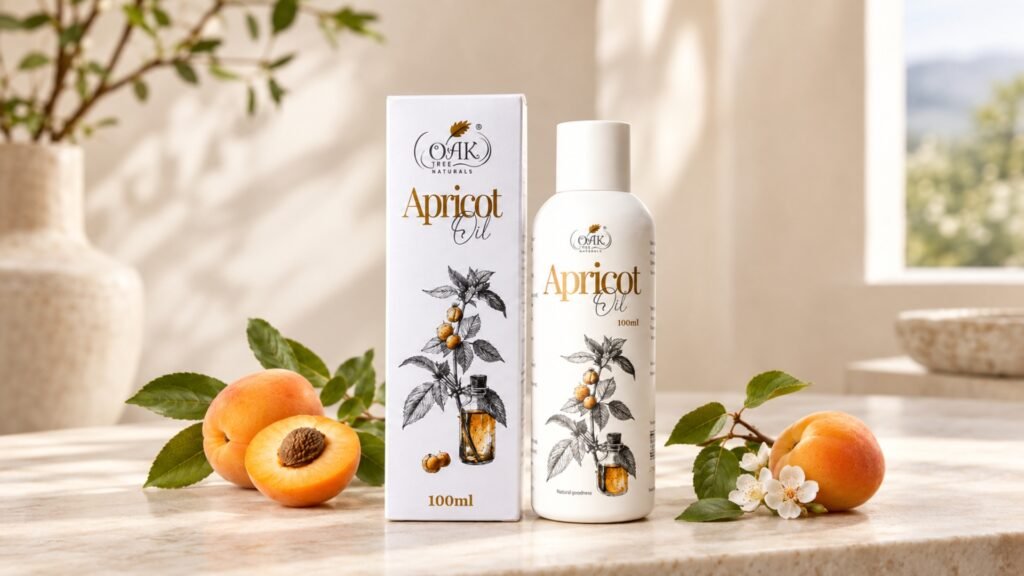
If you’re looking to add apricot oil to your personal-care routine, Oak Tree Naturals Apricot Oil (100 ml) is one option from the Oak Tree Naturals range.
The product can be incorporated into a simple skincare or hair-care routine where an oil-based conditioning step is appropriate.
The wider Oak Tree Naturals approach also emphasizes straightforward, nature-inspired personal care rather than requiring an unnecessarily complicated routine.
For the most accurate information about the product’s ingredients, intended use, directions, and storage, always refer to the product packaging and official product information.
Final Thoughts
So, what is apricot oil good for?
Its most practical uses are connected to moisturizing and conditioning. It can help dry-feeling skin feel softer, support smoother-looking skin, provide slip for facial massage, condition dry-feeling hair, and serve as a versatile oil for body care.
The seven key benefits covered here are:
- Helps moisturize dry-feeling skin
- Supports a softer, smoother skin feel
- Works well for facial massage
- Helps condition dry or rough hair
- Supports a comfortable dry-skin routine
- Can be used on dry areas of the body
- Fits easily into a simple skincare routine
The best way to use apricot oil is to keep expectations realistic. It is a cosmetic conditioning oil, not a cure-all ingredient. Start with a small amount, patch test first, and make it one part of a balanced skincare or hair-care routine.
If you’d like to try apricot oil as part of your routine, explore Oak Tree Naturals Apricot Oil (100 ml) and use it according to the product’s directions and intended application.
Frequently Asked Questions
1. What is apricot oil good for?
It is primarily used for moisturizing and conditioning. It can help dry-feeling skin feel softer and smoother and can also be used to condition dry or rough-feeling hair.
2. Can I use apricot oil on my face?
Yes, it can be used as a facial conditioning oil when the product is intended for topical use. Start with a few drops and patch test before applying it more widely.
3. Is apricot oil good for dry skin?
It can be useful for dry-feeling skin because it acts as an emollient, helping the skin feel softer and more conditioned.
4. Can apricot oil be used on hair?
Yes. A small amount can be used as a pre-shampoo treatment or applied to dry hair lengths and ends to improve the conditioned feel.
5. Can I use apricot oil every day?
It depends on how your skin or hair responds. If your skin tolerates it well, it may be incorporated into a routine. Start with a small amount rather than applying excessive oil.
6. Is apricot oil suitable for oily skin?
It may not be comfortable for everyone with oily skin. If you want to try it, use a very small amount and observe how your skin responds.
7. Does apricot oil replace moisturizer?
No. It primarily provides oil-based conditioning. Depending on your skin’s needs, you may still benefit from a moisturizer.
8. Does apricot oil replace sunscreen?
No, it should not be used as a substitute for sunscreen. Continue using an appropriate broad-spectrum sunscreen during the daytime.












