Face Glow and Even Skin Tone Serum Saffron: 7 Powerful Benefits for Radiant-Looking Skin

Want a brighter-looking complexion without an unnecessarily complicated routine?
Dull-looking skin, uneven appearance, and a lack of radiance are common reasons people add a face serum to their skincare routine. But with so many products available, it can be difficult to understand which ingredients are actually worth considering.
Saffron is one ingredient that continues to attract attention in skincare. Known botanically as Crocus sativus, it contains naturally occurring compounds such as crocin and crocetin. Research has investigated these compounds for antioxidant and skin-related properties, although much of the evidence remains laboratory-based or dependent on the specific saffron preparation being studied.
This is where a well-formulated Even Skin Tone Serum can become an interesting addition to a simple skincare routine.
In this guide, we will look at 7 potential benefits of saffron serum, how it can fit into your routine, what the research actually says, mistakes to avoid, and how to use an Even Skin Tone Serum without expecting overnight results.
Table of Contents
What Is a Saffron Face Serum?
A saffron face serum is a lightweight skincare product formulated with saffron or saffron-derived ingredients alongside other cosmetic ingredients.
Unlike a traditional cream, a serum is generally designed to provide a lighter-feeling layer of skincare. The actual benefits depend on the complete formulation, concentration, supporting ingredients, and how the product is used.
Saffron contains several naturally occurring compounds, including:
- Crocin
- Crocetin
- Picrocrocin
- Safranal
- Other phenolic and antioxidant compounds
Research has demonstrated antioxidant activity from saffron extracts, although the composition and activity can vary depending on saffron variety, growing conditions, and extraction method.
That distinction matters.
A study showing antioxidant activity from a concentrated saffron extract does not automatically prove that every saffron skincare product will produce the same result on human skin.
For consumers, the more useful question is therefore: How can a saffron serum reasonably fit into an everyday skincare routine?
7 Powerful Benefits of an Even Skin Tone Serum with Saffron
1. Helps Give Dull-Looking Skin a More Radiant Appearance
One of the main reasons people reach for a face serum is the desire for skin that looks fresher and more radiant.
Saffron contains antioxidant compounds, particularly crocin-related compounds, that have been investigated for their ability to interact with oxidative processes. Laboratory research has reported antioxidant activity in saffron extracts.
What does that mean for everyday skincare?
It means saffron is an interesting botanical ingredient for formulations designed around healthy-looking, radiant skin.
However, a serum should not be expected to transform the complexion overnight.
A better approach is to use it consistently as part of a broader routine that includes cleansing, moisturizing, and daytime sun protection.
2. Supports a More Even-Looking Complexion
Uneven-looking skin can result from several factors, including sun exposure, post-inflammatory changes, natural variation in pigmentation, and accumulated environmental stress.
Saffron-derived compounds have been investigated in relation to processes involved in pigmentation. For example, research on saffron floral extracts has examined tyrosinase activity in laboratory models.
That makes saffron an interesting cosmetic ingredient when discussing complexion-evening products.
But there is an important difference between supporting an even-looking complexion and claiming that a serum can eliminate pigmentation.
A realistic skincare goal is to support skin that looks:
- More radiant
- More uniform
- Fresher
- Smoother
- Less dull-looking
This is why choosing an Even Skin Tone Serum should be about consistent skincare rather than searching for an instant whitening effect.
3. Provides Antioxidant Support
Our skin is continuously exposed to environmental factors such as ultraviolet radiation and pollution.
These factors can contribute to oxidative stress within skin cells.
Saffron contains compounds with antioxidant activity, and studies have explored the antioxidant potential of saffron extracts and crocin.
A 2026 study investigating a topical cream containing saffron and grape seed extracts also reported antioxidant activity in laboratory testing. However, the study examined a specific cream formulation, not every saffron serum available on the market.
The research makes saffron scientifically interesting, but it should not be interpreted as proof that any particular saffron serum will provide a measurable anti-aging or protective effect.
4. Can Complement a Hydrating Skincare Routine
A serum is often used between cleansing and moisturizing because it adds another lightweight layer to the routine.
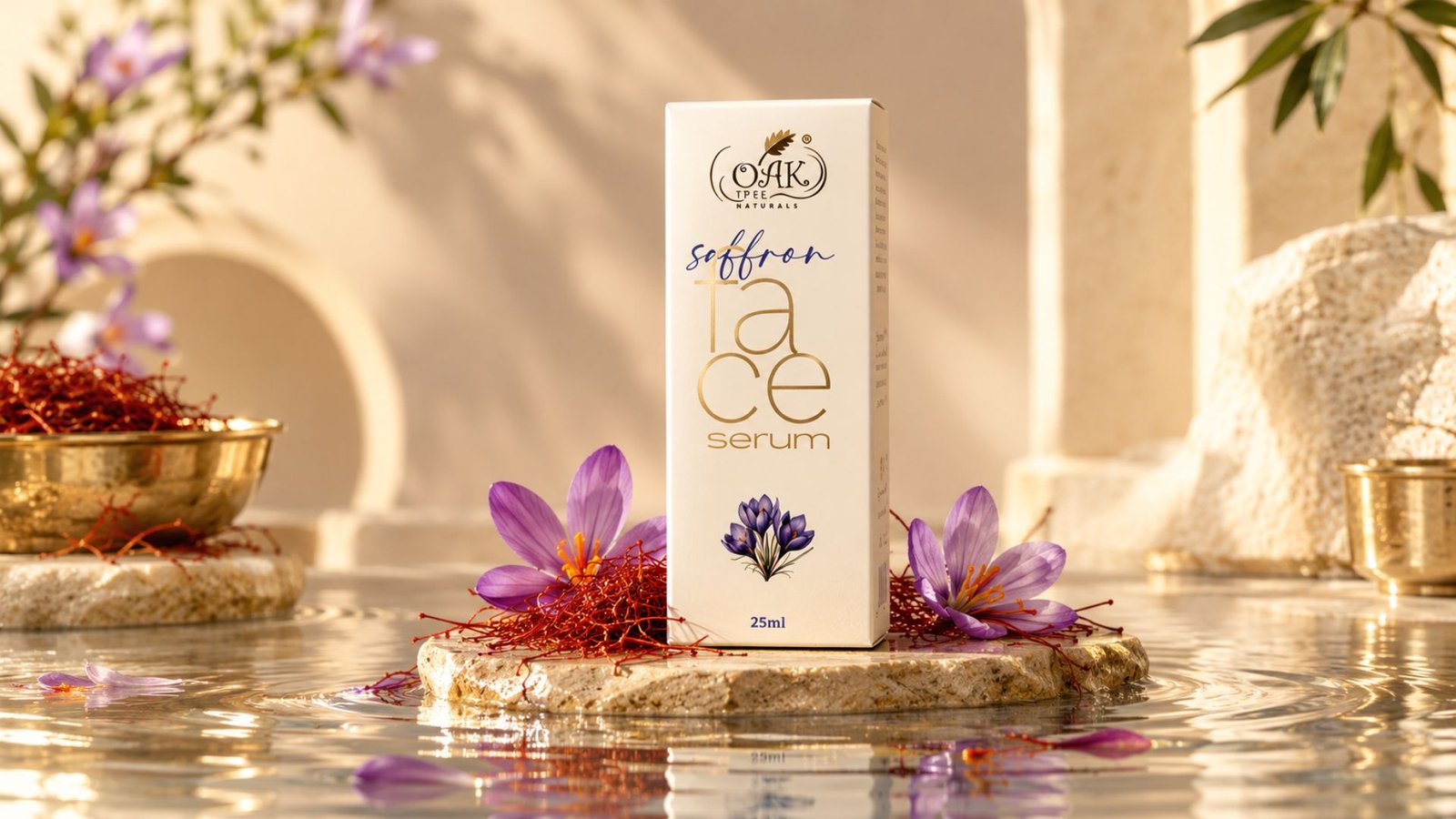
Oak Tree Naturals describes its Saffron Face Serum as a lightweight product intended to hydrate the skin while helping improve the appearance of dullness and leaving the complexion feeling soft, smooth, and refreshed.
This makes the product particularly relevant for someone who wants to introduce a serum without making their routine overly complicated.
A simple routine could look like:
Morning
- Gentle cleanser
- Saffron serum
- Moisturizer
- Sunscreen
Evening
- Cleanser
- Saffron serum
- Moisturizer
Remember that a serum is not automatically a substitute for moisturizer. The two products serve different roles depending on their formulations.
5. Helps Improve the Look of Tired, Dull Skin
Sometimes skin does not necessarily have a specific problem—it simply looks tired.
Lack of sleep, dehydration, environmental exposure, and an inconsistent skincare routine can all affect how fresh the complexion appears.
A lightweight serum can make a routine feel more complete while providing ingredients intended for cosmetic skin conditioning.
Saffron’s naturally occurring antioxidant compounds make it an appealing ingredient for products targeting a fresher-looking complexion.
For better results from any brightening-oriented routine, avoid relying on one product alone.
Think of skincare as a system:
Cleanse → Treat → Moisturize → Protect
Consistency generally matters more than continuously adding new products.
6. Fits Easily Into a Minimal Skincare Routine
One reason serums are popular is that they can be added without completely changing your routine.
You do not need a ten-step regimen to take care of your skin.
A practical routine can be as simple as:
Morning Evening
Cleanser Cleanser
Saffron serum Saffron serum
Moisturizer Moisturizer
Sunscreen —
If your skin already reacts well to a simple routine, adding too many active products at once may make it harder to understand what is actually helping—or causing irritation.
An Even Skin Tone Serum should therefore complement your existing routine rather than replace every other skincare step.
7. Can Add a Saffron-Based Step to Your Radiance Routine
Skincare is also about choosing products that you can realistically use consistently.
If you enjoy lightweight serums and want to explore botanical ingredients, saffron provides an interesting option.
Oak Tree Naturals’ Saffron Face Serum is positioned as a lightweight serum for hydration and a more radiant-looking complexion.
The product is available in a 25 ml format, making it a convenient addition for someone who wants to introduce a saffron-based serum into their regular routine.
You can explore the product here:
How to Use an Even Skin Tone Serum Correctly
Buying a serum is only one part of the process. Application matters too.
Step 1: Cleanse Your Face
Start with a gentle cleanser to remove accumulated dirt, excess oil, and other impurities.
Avoid aggressively scrubbing your skin.
Step 2: Apply the Serum
After cleansing, apply the recommended amount of serum according to the product directions.
Avoid getting the product directly into your eyes.
Step 3: Gently Spread It
Use clean fingertips to spread the serum evenly over your face.
There is no need to massage or rub the product vigorously.
Step 4: Follow With Moisturizer
Once the serum has been applied, use a moisturizer appropriate for your skin type.
Step 5: Use Sunscreen During the Day
This step is particularly important if your skincare goal involves maintaining a more even-looking complexion.
UV exposure can contribute to pigmentation and visible signs of photoaging. A cosmetic serum should therefore not be treated as a replacement for sun protection.
Use a broad-spectrum sunscreen during the daytime.
When Should You Apply a Saffron Face Serum?
The best time depends on the product instructions and the rest of your routine.
If the serum is suitable for both morning and evening use, you can incorporate it into either routine.
Morning Routine
Cleanser → Saffron Serum → Moisturizer → Sunscreen
Night Routine
Cleanser → Saffron Serum → Moisturizer
If you are introducing multiple new products, add them one at a time rather than changing your entire routine simultaneously.
That makes it easier to identify which product your skin responds well to.
How Long Does an Even Skin Tone Serum Take to Work?
This is one of the most important questions to ask before buying any skincare product.
A serum should not be judged after one or two applications.
Skin appearance changes gradually, and results can depend on:
- Skin type
- Existing pigmentation
- Sun exposure
- Skincare routine
- Product formulation
- Frequency of use
- Individual skin response
Also, “even skin tone” is not the same as changing your natural skin colour.
A sensible goal is healthier-looking, more balanced and radiant-looking skin rather than an unrealistic promise of instant fairness.
If pigmentation is persistent, worsening or associated with another skin concern, a dermatologist can help identify its cause and recommend evidence-based treatment.
Saffron Serum vs Traditional Face Cream
Both serums and creams can have a place in skincare, but they are not interchangeable.
Feature Saffron Face Serum Face Cream
Texture Usually lightweight Usually richer
Main role Targeted skincare step Moisturization/support
Application Often before moisturizer Often after serum
Suitable for layering Generally yes, depending on formulation Usually used as the final moisturizing step
Best for Adding a focused skincare layer Supporting skin comfort and moisture
The ideal choice depends on your skin type and what your existing routine lacks.
For example, someone with very dry skin may prefer to combine a lightweight serum with a richer moisturizer rather than expecting the serum to provide all the hydration they need.
Common Mistakes to Avoid
Mistake 1: Expecting Overnight Results
A serum is not a magic eraser for dullness or pigmentation.
Give your skincare routine enough time and focus on consistency.
Mistake 2: Skipping Sunscreen
If uneven pigmentation is one of your concerns, skipping daytime sun protection can work against your overall skincare goals.
A serum should complement sunscreen—not replace it.
Mistake 3: Using Too Many Active Products
Combining multiple exfoliating acids, retinoids, and brightening products at once can increase the risk of irritation.
Keep the routine manageable.
Mistake 4: Applying Excessive Amounts
More serum does not necessarily mean better results.
Follow the product directions and use an appropriate amount.
Mistake 5: Ignoring Skin Sensitivity
Even botanical ingredients can cause irritation in some individuals.
Patch-testing a new product before applying it broadly can be a sensible precaution, particularly if your skin is sensitive or reactive.
Is Saffron Actually Good for Skin?
There is scientific interest in saffron as a cosmetic ingredient, particularly because of compounds such as crocin and crocetin.
Laboratory and preclinical research has reported antioxidant-related activity from saffron extracts and crocin. One study, for example, found that crocin reduced UVB-associated oxidative stress markers in cultured human dermal fibroblasts.
Another study examining saffron flower extracts reported antioxidant and other dermo-protective activities in laboratory models.
However, this evidence needs to be interpreted carefully.
Laboratory findings are not equivalent to proven cosmetic results in humans.
The concentration, extraction method, formulation, and delivery system can all affect how an ingredient behaves.
That is why a responsible skincare article should describe saffron as a promising botanical ingredient, rather than claiming it can definitively treat pigmentation, reverse aging, or guarantee an even skin tone.
Who Can Consider a Saffron Face Serum?
A saffron serum may be worth considering if you want:
- A lightweight serum in your routine
- A botanical skincare ingredient
- A product aimed at dull-looking skin
- A simple step before moisturizer
- A serum designed to support a radiant-looking complexion
It may not be the right choice if your primary concern requires medical treatment rather than cosmetic skincare.
For persistent melasma, significant pigmentation, unexplained skin changes, or recurring irritation, professional dermatological advice is more appropriate.
The Bottom Line
A good skincare routine does not need to be complicated.
Saffron is an interesting botanical ingredient because it contains compounds such as crocin and crocetin that have demonstrated antioxidant activity in laboratory and preclinical research.
An Even Skin Tone Serum can therefore be a useful cosmetic step for people who want to support a fresh, smooth and radiant-looking complexion.
But expectations matter.
Rather than looking for instant transformation, focus on consistent application, adequate moisturization, gentle cleansing and daily sun protection.
For those who want a ready-to-use saffron serum, Oak Tree Saffron Face Serum is positioned by Oak Tree Naturals as a lightweight serum that helps hydrate the skin, improve the appearance of dullness, and leave the complexion looking soft, smooth, and refreshed.
Explore Oak Tree Saffron Face Serum
FAQ Section
1. What is a saffron face serum used for?
A saffron face serum is generally used as a lightweight skincare step to support hydration and a more radiant-looking complexion. Its actual effects depend on the complete formulation and individual skin response.
2. Can saffron serum help with un-even skin tone?
Saffron contains compounds that have demonstrated antioxidant and pigmentation-related activity in laboratory research. However, evidence for noticeable complexion-evening effects from topical saffron products in humans remains limited, so results should not be guaranteed.
3. How should I use an Even Skin Tone Serum?
Apply the serum after cleansing and before moisturizer, following the product’s directions. During the daytime, finish with sunscreen.
4. Can I use saffron serum every day?
If the specific product is designed for regular use and your skin tolerates it, it can be incorporated into a daily routine according to the manufacturer’s directions.
5. Can saffron serum replace moisturizer?
Usually, no. A serum and moisturizer can perform different roles. A serum can provide a lightweight skincare layer, while a moisturizer is generally designed to support hydration and the skin barrier.
6. Is saffron serum suitable for sensitive skin?
It may be suitable for some people, but sensitive skin can react to botanical or fragranced ingredients. Patch-test a new product and discontinue use if irritation occurs.
7. Does saffron serum make skin fair?
A responsible skincare product should not be expected to change your natural skin colour. A more realistic goal is supporting skin that looks radiant, smooth, and more even in appearance.
8. Do I still need sunscreen when using saffron serum?
Yes. A saffron serum is not a substitute for sunscreen. Use an appropriate broad-spectrum sunscreen during the day, particularly when pigmentation or un-even skin tone is a concern.