
How to Use Kumkumadi Oil on Face: 7 Amazing Tips for Glowing, Radiant Skin

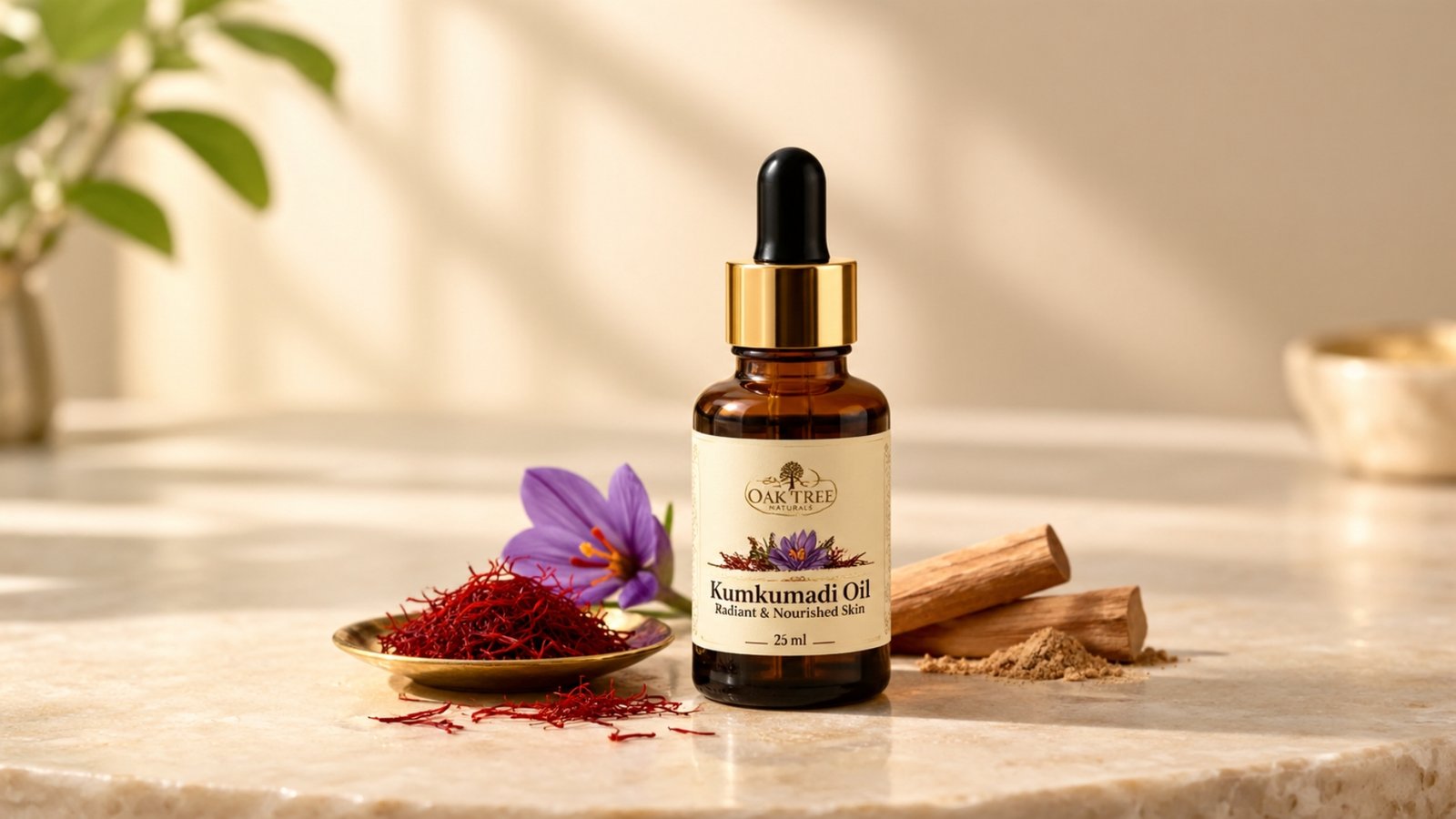
Kumkumadi oil is a traditional Ayurvedic facial oil that has become popular in modern skincare routines. If you are wondering how to use it on your face, the most important things to understand are how much to apply, when to use it, how to massage it, and how to introduce it according to your skin’s needs.
Kumkumadi formulations can contain several botanical ingredients, and different products may use different formulations. Oak Tree Naturals describes its Kumkumadi Oil 25 ml as being enriched with saffron, sandalwood, and herbal extracts, with the product positioned for nourishing the skin, supporting the appearance of an even skin tone, and leaving skin radiant and refreshed.
There is also some emerging scientific interest in Kumkumadi Taila. A 2026 exploratory study involving 30 healthy adults examined once-daily facial use for 15 days and reported changes in several measured skin parameters, including melanin index, erythema, hydration, and elasticity. However, it was a small, short-term, single-arm study, so the findings should be viewed as preliminary rather than proof of a treatment effect.
This guide explains how to use Kumkumadi oil on the face in a simple, practical way while keeping realistic expectations about what facial oils can and cannot do.
Table of Contents
What Is Kumkumadi Oil?
Kumkumadi oil, also called Kumkumadi Taila or Kumkumadi Tailam, is a traditional Ayurvedic facial oil preparation.
The formulation is generally associated with saffron and other botanical ingredients. However, there is no single modern formula used by every manufacturer. The ingredients, base oils, preparation methods, and concentrations can differ from one product to another.
That is why it is useful to check the label of the particular Kumkumadi oil you are using rather than assuming that every product has exactly the same composition.
Oak Tree Naturals’ product listing describes its Kumkumadi Oil as containing saffron, sandalwood, and herbal extracts and markets it for nourishing and hydrating the skin while supporting a radiant appearance. (oaktreenaturals.in)
Why is Kumkumadi oil used on the face?
People commonly incorporate facial oils into their routines because they can provide a conditioning, emollient feel. Kumkumadi oil is particularly associated with traditional Ayurvedic facial care.
Depending on the formulation and your skin type, it can be used as a small final step in a nighttime routine.
The key is using a small amount rather than assuming that more oil means better results.
How to Use Kumkumadi Oil on Face: 7 Amazing Tips
If you are new to Kumkumadi oil, follow these seven practical tips.
1. Start With a Clean Face
The first step is simple: cleanse your face before applying the oil.
A gentle cleanser can remove accumulated dirt, excess oil, sunscreen, and makeup. After cleansing, gently pat your skin dry rather than rubbing it aggressively.
Dermatologists generally recommend cleansing before applying skincare products, followed by treatment products and then moisturizer and/or sunscreen as appropriate.
A simple nighttime sequence can therefore look like:
Cleanser → treatment/serum if used → moisturizer if needed → Kumkumadi oil
The exact order can vary depending on the rest of your routine and the product instructions.
2. Use Only a Small Amount
One of the most common mistakes when using a facial oil is applying too much.
Start with a few drops or the amount recommended on your product label. You can always adjust the quantity according to how your skin feels.
Using excessive oil may leave your face feeling unnecessarily greasy, especially if you have oily or combination skin.
A useful approach is:
- Start with a small quantity.
- Spread it evenly between your fingertips.
- Apply gently to the face.
- Add more only if your skin actually needs it.
The goal is to lightly condition the skin, not leave a thick layer of oil on the surface.
3. Warm the Oil Between Your Fingertips
Before applying Kumkumadi oil, place the recommended amount on your fingertips and gently spread it between them.
This makes it easier to distribute the oil evenly instead of placing several concentrated drops on different areas of your face.
You do not need to rub or heat the oil aggressively.
Simply warming and spreading a small amount between your fingertips is enough to make application easier.
4. Massage Gently Instead of Rubbing Hard
Once the oil is distributed between your fingertips, gently apply it across your face.
Use light, comfortable movements rather than vigorous rubbing.
You can work across areas such as:
- Forehead
- Cheeks
- Chin
- Jawline
- Sides of the face
Be particularly gentle around the eye area.
If your skin is sensitive, irritated, sunburned, or experiencing an active flare-up, avoid aggressive massage. Dermatologists generally advise gentle handling of sensitive or easily irritated skin.
How long should you massage Kumkumadi oil?
There is no need for a long massage session.
A gentle application that distributes the product evenly is sufficient. If massage itself causes redness, burning, or discomfort, stop rather than continuing in an attempt to get better results.
5. Nighttime Can Be a Convenient Time to Use It
Many people prefer facial oils as part of their night skincare routine.
Using Kumkumadi oil at night can be practical because you do not have to layer it underneath daytime makeup or sunscreen.
A simple routine could be:
Step 1: Cleanse
Step 2: Apply any treatment products you normally use
Step 3: Moisturize if needed
Step 4: Apply a small amount of Kumkumadi oil
However, nighttime use should not be presented as a universal rule. Your product’s instructions should take priority.
If you use Kumkumadi oil during the day, remember that facial oil does not replace sunscreen. Daily sun protection remains an important part of skincare, particularly when your goal involves maintaining an even-looking complexion. (American Academy of Dermatology)
6. Patch Test Before Applying It All Over Your Face
Even botanical or Ayurvedic skincare products can cause irritation or allergic reactions in some people.
This is why patch testing is a sensible step when introducing a new product.
The American Academy of Dermatology recommends testing skincare products on a small area before regular use. Its guidance suggests applying the product to a small test area twice daily for 7–10 days and monitoring for reactions such as redness, itching, or swelling. (American Academy of Dermatology)
This is particularly worth considering if you have:
- Sensitive skin
- A history of product reactions
- Easily irritated skin
- Known ingredient allergies
- A compromised skin barrier
If a product causes burning, significant itching, swelling, or a rash, stop using it.
Also remember that “natural” does not automatically mean irritation-free. Botanical ingredients can still trigger contact dermatitis in susceptible individuals.
7. Give Your Skin Time and Keep Your Routine Simple
Skincare usually works better as a consistent routine than as a series of constantly changing products.
If Kumkumadi oil fits your skin type, introduce it gradually and observe how your skin responds.
Avoid adding several new products at the same time. Otherwise, if you develop irritation, it becomes much harder to identify which product caused it.
It is also important to keep expectations realistic.
A small exploratory study on Kumkumadi Taila found changes in selected facial skin measurements after 15 days, but that does not establish that every Kumkumadi oil will produce the same results or that pigmentation, acne, or other skin conditions can be treated with the oil.
Think of Kumkumadi oil as a skincare product that may complement your routine—not as a replacement for professional treatment when you have a persistent skin concern.
How to Use Kumkumadi Oil on Face: Step-by-Step
If you want the shortest practical routine, follow these steps:
- Cleanse your face with a gentle cleanser.
- Pat your skin dry without rubbing.
- Take a small amount of Kumkumadi oil according to the product directions.
- Spread it between your fingertips for easier application.
- Gently apply it across the face.
- Massage lightly without vigorous rubbing.
- Leave it on or follow the product directions regarding removal.
- Use sunscreen during the daytime as part of your normal skincare routine.
The important point is consistency and moderation—not applying a large quantity.
How Often Should You Use Kumkumadi Oil?
There is no single frequency that is appropriate for every person.
Your skin type, the formulation, and the rest of your skincare routine all matter.
Skin Type Practical Approach
Dry skin A small amount may feel comfortable as part of a nourishing routine.
Normal skin Start with a small amount and observe how your skin responds.
Combination skin Use less on areas that already feel oily.
Oily skin Start with a very small amount rather than applying a heavy layer.
Sensitive skin Patch test first and introduce gradually.
Acne-prone skin Check the ingredient list and monitor for irritation or breakouts.
There is no need to force daily use if your skin does not tolerate it comfortably.
Kumkumadi Oil for Dark Spots: What Can You Expect?
Dark spots are one of the reasons people search for Kumkumadi oil.
There is some preliminary research worth mentioning. In the 2026 exploratory study, once-daily Kumkumadi Taila use was associated with a reduction in measured facial melanin index over 15 days. The study also reported changes in erythema and other skin parameters.
However, this should not be interpreted as proof that Kumkumadi oil can permanently remove dark spots.
Pigmentation can have many causes, including:
- Previous acne or inflammation
- Sun exposure
- Hormonal changes
- Skin injury
- Certain medications
- Underlying skin conditions
If pigmentation is persistent, worsening, suddenly appearing, or associated with other symptoms, a dermatologist can help determine the underlying cause.
Most importantly, do not rely on a facial oil alone if your main concern is pigmentation. Sun protection is an important part of managing the appearance of uneven pigmentation.
Can Kumkumadi Oil Make Skin Glow?
It can contribute to a more nourished, conditioned, or radiant-looking appearance, particularly when used appropriately for your skin type.
But “glow” is a cosmetic description rather than a medical outcome.
Healthy-looking skin depends on several factors, including hydration, skin texture, pigmentation, cleansing, moisturization, and sun protection.
Kumkumadi oil should therefore be viewed as one part of a broader skincare routine, rather than the single product responsible for every improvement in the appearance of the skin.
Can You Use Kumkumadi Oil With Other Skincare Products?
Yes, but simplicity is often useful.
If you already use several active skincare products—such as retinoids, exfoliating acids, or other treatments—adding another product can make irritation more difficult to manage.
The AAD notes that using too many skincare products can irritate the skin and recommends following an appropriate product sequence. (American Academy of Dermatology)
A basic routine might look like:
Morning
Cleanser → Moisturizer → Sunscreen
Night
Cleanser → Treatment, if needed → Moisturizer → Kumkumadi oil
This is only a general framework. Product directions and your dermatologist’s recommendations should take priority.
Common Mistakes to Avoid When Using Kumkumadi Oil
Applying too much
More oil does not automatically mean greater benefits. Start small.
Skipping a patch test
Even natural botanical ingredients can cause reactions in some individuals.
Rubbing aggressively
Facial skin does not need forceful massage. Gentle application is usually sufficient.
Expecting overnight changes
Cosmetic skincare results vary between individuals. Avoid products or claims promising dramatic overnight transformation.
Forgetting sunscreen
Facial oil is not a substitute for sun protection.
Assuming every Kumkumadi oil is identical
Different brands can use different ingredients and preparation methods. Always check the product label.
Oak Tree Naturals Kumkumadi Oil
Oak Tree Naturals lists its Kumkumadi Oil 25 ml as a facial-care product containing saffron, sandalwood, and herbal extracts. The brand describes it as a nourishing oil intended to support the appearance of dark spots, an even-looking skin tone, hydration, and a radiant, refreshed appearance.
Explore Oak Tree Naturals Kumkumadi Oil 25 ml.
The product should be used according to its label directions. If you are introducing it, patch testing is a sensible precaution, especially if your skin is sensitive or reactive.
Final Thoughts
Knowing how to use Kumkumadi oil on the face is less about applying a large quantity and more about using it thoughtfully.
Start with a clean face, use a small amount, apply it gently, and introduce it gradually. Pay attention to how your skin responds rather than assuming that a traditional or natural product will suit everyone equally.
Kumkumadi oil has a long history in Ayurvedic facial care, and recent preliminary research has begun investigating its effects using measurable skin parameters. However, the scientific evidence is still developing, so realistic expectations are important. (PubMed)
For everyday skincare, keep the fundamentals in place: gentle cleansing, appropriate moisturization, and daytime sun protection. A facial oil can then be added according to your skin’s needs and tolerance.

FAQ Section
1. How do you use Kumkumadi oil on face?
Cleanse your face, take a small amount of oil, spread it between your fingertips, and gently apply it to your face. Use it according to the product directions and introduce it gradually if you are new to facial oils.
2. Can I use Kumkumadi oil every day?
Some people may incorporate it regularly, but frequency depends on skin type, product formulation, and tolerance. If you have sensitive or acne-prone skin, start less frequently and monitor your skin.
3. Should I use Kumkumadi oil at night or during the day?
Nighttime can be a convenient option for facial oil, but follow the specific product instructions. If you use it during the day, it should not replace sunscreen.
4. Can Kumkumadi oil help with dark spots?
Preliminary research has found changes in measured facial melanin index after short-term Kumkumadi Taila use, but the evidence is limited and does not prove that every product will remove dark spots. (PubMed)
5. Is Kumkumadi oil suitable for oily skin?
It may be possible to use a facial oil on oily skin, but quantity matters. Start with a very small amount and monitor whether your skin feels excessively greasy or develops breakouts.
6. Should I wash my face after applying Kumkumadi oil?
That depends on the product directions. If the label instructs you to leave the oil on, you do not need to wash it off immediately.
7. Should I patch test Kumkumadi oil?
Yes. Patch testing a new skincare product can help identify possible irritation before applying it broadly to your face. The AAD recommends testing skincare products on a small area before regular use. (American Academy of Dermatology)
8. Can I use Kumkumadi oil with moisturizer?
Yes, depending on your routine and the formulation. A facial oil can be incorporated after moisturizer, although the ideal order can vary. The AAD recommends considering the overall sequence of cleansing, treatments, moisturizer, and sunscreen.













One thought on “How to Use Kumkumadi Oil on Face: 7 Amazing Tips for Glowing, Radiant Skin”