
Is Kumkumadi Oil Good for Oily Skin? The Ultimate Guide to Glowing Skin


Is Kumkumadi Oil Good for Oily Skin? Learn how to use Kumkumadi oil, its benefits, precautions, and whether it suits oily and acne-prone skin.
If you have oily skin, you probably think twice before putting an oil on your face. After all, your skin already produces excess sebum, so why add more oil?
That makes the question “is kumkumadi oil good for oily skin?” a very reasonable one.
Kumkumadi oil is a traditional Ayurvedic facial oil known for its botanical ingredients and use in skincare routines focused on a healthy-looking, radiant complexion. But “natural oil” does not automatically mean that it will suit every oily or acne-prone face.
The answer depends on your skin type, the particular formulation, how much you use, and how your skin responds.
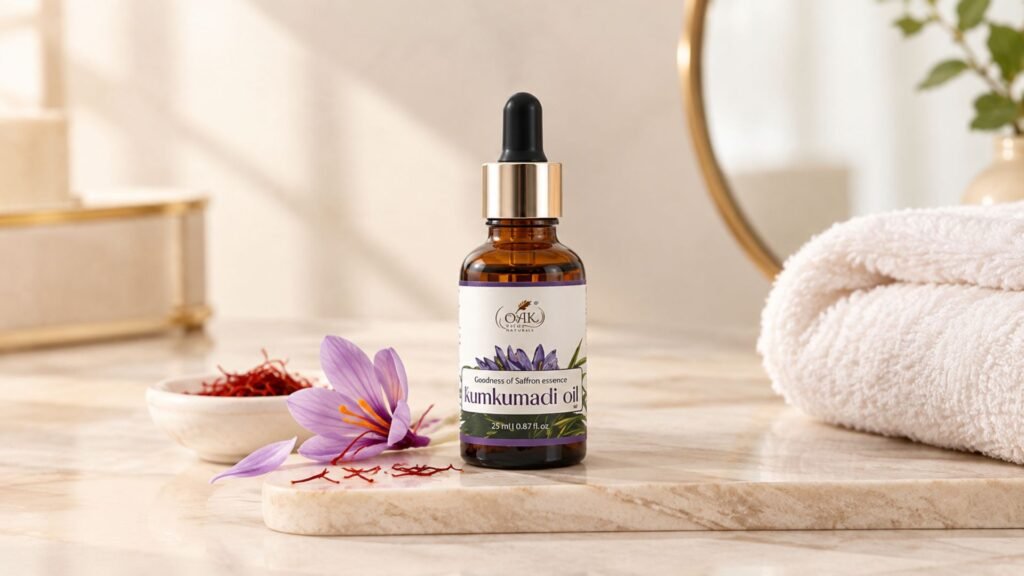
Oak Tree Naturals Kumkumadi Oil is a 25 ml facial oil formulated with ingredients including saffron, sandalwood, and herbal extracts. The brand describes it as suitable for all skin types and positions it around concerns such as the appearance of dark spots, uneven-looking skin tone, hydration and radiance.
So, should someone with oily skin use it?
Let’s look at what Kumkumadi oil is, what it can realistically do, how oily skin can approach facial oils, and how to use it without turning your skincare routine into an unnecessarily greasy experience.
Table of Contents
Is Kumkumadi Oil Good for Oily Skin?
Kumkumadi oil can be used by some people with oily skin, but it may not suit everyone.
Oily skin does not mean that your skin needs to avoid every oil-based product. At the same time, adding a rich facial oil to already oily or acne-prone skin can feel heavy and may not be the best choice for everyone.
The American Academy of Dermatology recommends that people with oily or acne-prone skin look for skincare products labelled oil-free or non-comedogenic, particularly when clogged pores and breakouts are concerns.
That means you should approach Kumkumadi oil differently depending on your skin.
For example:
- Oily but not acne-prone: You may be able to use a very small amount comfortably.
- Combination skin: You may prefer using less oil on the naturally oily areas.
- Oily and acne-prone: Introduce it cautiously and monitor how your skin responds.
- Sensitive skin: Patch testing is particularly important.
- Normal or dry skin: A facial oil may feel more comfortable because these skin types often tolerate richer conditioning products better.
So the answer isn’t simply “yes” or “no.”
The better question is: Does this particular Kumkumadi oil work well with your skin?
What Is Kumkumadi Oil?
Kumkumadi oil, also called Kumkumadi Tailam or Kumkumadi Taila, is a traditional Ayurvedic facial oil preparation.
The formulation is associated with saffron and can contain multiple botanical ingredients. However, formulations can vary between manufacturers, so two products carrying the name “Kumkumadi oil” may not necessarily contain the same ingredients.
Oak Tree Naturals’ Kumkumadi Oil is described as containing saffron, sandalwood, and herbal extracts. The brand markets the 25 ml product for facial care and says it is suitable for all skin types.
This distinction matters when you’re choosing an oil for oily skin.
Don’t judge a facial oil only by its name. Check the actual formulation.
Why Would Someone With Oily Skin Want to Use Facial Oil?
This is where skincare gets interesting.
Oily skin and dehydrated skin aren’t necessarily the same thing.
Your skin can produce excess oil while still lacking adequate water and feeling uncomfortable or tight. Dermatologists also recommend moisturizing oily skin rather than trying to strip away its natural oils completely.
A well-balanced skincare routine is therefore not about removing every trace of oil.
It’s about maintaining a comfortable balance.
A facial oil can provide emollient and conditioning properties, which may help skin feel softer and more comfortable. But that doesn’t mean everyone with oily skin needs one.
If your current routine already leaves your skin comfortable and balanced, adding another rich product may not be necessary.
Potential Benefits of Kumkumadi Oil for Oily Skin
1. It Can Support a Healthy-Looking Glow
One of the reasons Kumkumadi oil attracts so much attention is its association with radiant-looking skin.
Oak Tree Naturals positions its Kumkumadi Oil around enhancing natural glow and supporting a more even-looking complexion.
The important distinction is between radiance and skin whitening.
Healthy-looking skin can appear more luminous because of hydration, smoother texture, and an even appearance. That is different from trying to change your natural skin colour.
2. It Can Provide Conditioning
Even oily skin benefits from a well-maintained skin barrier.
Facial oils can act as emollients, helping the skin feel softer and more conditioned.
However, this doesn’t mean that applying more oil gives better results.
For oily skin, less can often be more practical.
Instead of covering your face in a thick layer, start with a very small quantity and see how your skin responds.
3. It Can Be Part of a Nighttime Routine
Kumkumadi oil is particularly easy to incorporate into a nighttime skincare routine.
After cleansing, you can use a small amount according to the product instructions.
Nighttime use can also be convenient if you find facial oils too shiny for daytime wear.
A simple routine could be:
Cleanser → Moisturizer if needed → Small amount of Kumkumadi oil
You don’t need a ten-step routine to take care of your skin.
4. It May Support a More Even-Looking Complexion
Uneven skin tone is another reason people are interested in Kumkumadi oil.
A recent exploratory human study involving 30 healthy adults examined Kumkumadi Taila and reported changes in several skin parameters, including a reduction in measured facial melanin index after 15 days. However, the study was small, short-term, and exploratory, so it should not be treated as conclusive evidence that Kumkumadi oil removes pigmentation.
This is an important distinction.
Kumkumadi oil may be interesting as a cosmetic skincare product, but persistent pigmentation can have many causes and may require professional evaluation.
5. It Can Complement a Hydrating Skincare Routine
Oily skin doesn’t necessarily mean hydrated skin.
If your face feels oily on the surface but tight or uncomfortable underneath, your routine may need better hydration rather than harsher cleansing.
The American Academy of Dermatology recommends that people with oily skin still use moisturizer because maintaining skin hydration is important. (American Academy of Dermatology)
Kumkumadi oil can potentially be used as a conditioning step, although it should not automatically replace a moisturizer designed for your particular skin type.
What About Acne-Prone Oily Skin?
This is where you should be more careful.
If your oily skin is also acne-prone, adding a facial oil requires more consideration.
The AAD recommends that acne-prone individuals look for products labelled oil-free, non-comedogenic, or “won’t clog pores.” (American Academy of Dermatology)
Not every facial oil will work equally well for every acne-prone person.
And there’s another important point:
Kumkumadi oil should not be treated as an acne treatment.
If you have persistent acne, painful breakouts, or significant inflammation, a dermatologist can help identify the appropriate treatment.
If you do want to try Kumkumadi oil cosmetically, introduce it slowly and watch for:
- New or worsening breakouts
- Persistent redness
- Itching
- Burning
- Small bumps
- Excessive greasiness
If these occur, stop using the product and reassess your routine.
How to Use Kumkumadi Oil on Oily Skin
If you’re wondering if Kumkumadi oil is good for oily skin but don’t want to commit to using it every night immediately, start slowly.
Step 1: Cleanse Your Face
Use a gentle cleanser to remove sweat, dirt, sunscreen, and excess oil.
Avoid aggressively scrubbing your skin. The AAD notes that harsh cleansing and scrubbing can irritate oily skin. (American Academy of Dermatology)
Step 2: Start With a Very Small Amount
This is particularly important for oily skin.
You don’t need to soak your face in oil.
Start with a few drops or the amount recommended on the product packaging.
Step 3: Gently Apply
Warm the oil between your fingertips and gently spread it over your face.
There’s no need for aggressive massage.
Step 4: Use It at Night
If you dislike a shiny appearance during the day, nighttime is a convenient opportunity to use a facial oil.
Step 5: Monitor Your Skin
Give your skin time to tell you whether it likes the product.
If your face feels excessively greasy or you notice new breakouts, reconsider the frequency or discontinue use.
How Much Kumkumadi Oil Should You Use on Oily Skin?
This is one of the most important practical questions.
Start small.
A common mistake with facial oils is assuming that more product means greater benefits.
It doesn’t.
Your goal is to condition the skin lightly rather than create a thick oily layer.
If a few drops are enough to spread comfortably over your face, there’s no reason to keep adding more.
This is particularly relevant for oily skin because excessive product can make the skin feel heavy and uncomfortable.
Should You Use Kumkumadi Oil Every Day?
Not necessarily.
Some people may comfortably use it regularly, while others may prefer using it only a few times a week.
If you have oily or sensitive skin, introducing it gradually is a sensible approach.
For example:
Week 1: Use it once or twice and observe your skin.
Week 2: If your skin remains comfortable, consider increasing frequency.
After that: Adjust according to how your skin responds.
Your skin doesn’t need to follow a rigid calendar.
If a product works well for you, consistency matters more than using excessive amounts.
Kumkumadi Oil vs. Heavy Facial Oils: What Should Oily Skin Look For?
When shopping for a facial oil, don’t stop at “natural,” “Ayurvedic,” or “herbal.”
Look at the formulation.
Consider:
What to Check | Why It Matters
Ingredient list Helps you understand what you’re applying
Base oils Can influence texture and how rich the product feels
Botanical ingredients Some people may be sensitive to certain botanicals
Fragrance Can be relevant for sensitive skin
Product directions Helps you use the product appropriately
Your skin type Determines how much and how often you may feel comfortable
A reputable product should provide clear information about ingredients, use, and storage.
Oak Tree Naturals lists its Kumkumadi Oil as a 25 ml facial-care product containing saffron, sandalwood, and herbal extracts.
Can Kumkumadi Oil Make Oily Skin More Oily?
It can feel more oily, particularly if you apply too much.
That’s different from saying that the oil will necessarily increase your skin’s natural sebum production.
If your face already becomes shiny quickly, using a heavy layer of facial oil may be uncomfortable.
That’s why the best approach for oily skin is:
Small quantity + gradual introduction + observe your skin.
You don’t have to completely avoid facial oils. You need to use them thoughtfully.
Common Mistakes When Using Kumkumadi Oil on Oily Skin
Using too much
A thick layer isn’t necessary.
Applying it without cleansing
Oil, sweat, dirt, and sunscreen should not simply be layered underneath a new skincare product.
Expecting instant pigmentation removal
Pigmentation can have many causes and generally shouldn’t be approached with unrealistic expectations.
Skipping sunscreen
Kumkumadi oil isn’t a substitute for sunscreen. If pigmentation or uneven tone is a concern, daytime sun protection remains an important part of skincare.
Introducing several new products together
If you suddenly add an oil, serum, cleanser, and cream at the same time, it becomes difficult to know which product your skin likes or dislikes.
Ignoring breakouts
If your acne gets worse after introducing a product, don’t keep using it simply because it’s labelled “natural.”
Is Oak Tree Naturals Kumkumadi Oil Worth Considering for Oily Skin?
If you’re specifically looking for an Ayurvedic-inspired facial oil, Oak Tree Naturals Kumkumadi Oil 25 ml is one option to consider.
The product is listed with saffron, sandalwood, and herbal extracts, and Oak Tree Naturals describes it as suitable for all skin types. The brand also positions it around hydration, dark-spot appearance, even-looking skin tone, and radiance.
For someone with oily skin, the key is not to automatically use a large amount simply because the product is marketed as nourishing.
Start with a small quantity.
See how your skin feels.
And if you’re acne-prone, be particularly attentive to clogged pores and breakouts.
That approach makes your skincare routine more personalized instead of assuming that one product will work identically for everyone.
A Simple Kumkumadi Oil Routine for Oily Skin
Here’s a straightforward routine you can try:
Morning
- Gentle cleanser
- Lightweight moisturizer if needed
- Broad-spectrum sunscreen
Night
- Gentle cleanser
- Lightweight moisturizer if needed
- A small amount of Kumkumadi oil
If the oil feels too heavy when layered over moisturizer, you can adjust the order or frequency based on the product instructions and how your skin responds.
Remember: the goal is balanced, comfortable skin—not maximum product.
So, Is Kumkumadi Oil Good for Oily Skin?
The answer is that it can be, but it isn’t automatically ideal for every oily face.
Kumkumadi oil can provide conditioning and may fit into a skincare routine focused on a healthy-looking, radiant complexion. Early research into Kumkumadi Taila is interesting, particularly around measurements such as pigmentation, hydration, and redness, but current human evidence remains limited.
For oily skin, the smartest approach is to:
- Use a small amount
- Introduce it gradually
- Check the ingredient list
- Patch test if you have sensitive skin
- Monitor for breakouts
- Avoid aggressive cleansing
- Continue using appropriate sunscreen
- Stop if the product causes persistent irritation
And if your skin is persistently acne-prone, painful, irritated, or difficult to manage, a dermatologist can help you choose products that are better suited to your specific condition.
Kumkumadi oil doesn’t need to be treated as a miracle product to be interesting. Its traditional formulation, botanical ingredients, and growing scientific interest make it a compelling addition to some skincare routines—provided you use it according to your skin’s needs.
FAQ / People Also Ask
Is Kumkumadi oil suitable for oily skin?
It may be suitable for some people with oily skin when used in a small amount. However, facial oils can feel heavy for some oily or acne-prone individuals, so gradual introduction is recommended.
Can oily skin use Kumkumadi oil every day?
Some people may tolerate regular use, but daily use isn’t necessary for everyone. Start gradually and adjust according to your skin’s response.
Will Kumkumadi oil clog pores?
That depends on the formulation and individual skin response. If you’re acne-prone, look carefully at the ingredient list and consider products specifically labelled non-comedogenic or oil-free where appropriate. (American Academy of Dermatology)
Can Kumkumadi oil reduce dark spots?
Early research has found changes in measured facial pigmentation after Kumkumadi Taila use, but current evidence is limited. It should not be considered a proven treatment for pigmentation.
Can Kumkumadi oil cause pimples?
It may not suit everyone with acne-prone skin. If you notice new or worsening breakouts after introducing it, stop using it and reassess your routine.
Can I use Kumkumadi oil with moisturizer?
Yes, depending on your skin type and the product directions. If you’re oily, avoid automatically layering large amounts of both products.
Is Kumkumadi oil good for glowing skin?
Kumkumadi oil is traditionally used for facial care and is marketed for supporting radiant-looking skin. Its conditioning properties can also help skin feel softer and more moisturized.
When should I use Kumkumadi oil?
Many people prefer using facial oils at night. Follow the specific instructions provided with your product.













2 thoughts on “Is Kumkumadi Oil Good for Oily Skin? The Ultimate Guide to Glowing Skin”