Dry & Frizzy Hair? Discover Why Aloe Vera Gel Could Be Your New Hair-Care Essential


Some hair days seem impossible to fix.
You wash your hair, condition it, let it dry—and somehow, your hair still looks dry, rough, and frizzy. Then come the flyaways, tangled ends, and the feeling that your hair needs yet another product.
But what if your hair-care routine didn’t need to become more complicated?
Aloe vera gel for hair has become a popular choice for people looking for a lightweight way to care for dry-looking, difficult-to-manage hair. Aloe vera is well known as a topical ingredient, and its gel has a light, water-rich texture that makes it appealing for everyday personal care. However, scientific evidence for aloe vera’s specific hair benefits is much less established than its popularity online might suggest.
That doesn’t mean you have to dismiss it.
It simply means you should understand what aloe vera gel can realistically do, how to use it, and what it cannot do before making it a regular part of your routine.
So, if dry and frizzy hair is constantly testing your patience, here’s what you need to know.
Table of Contents
Why Does Hair Become Dry and Frizzy?
Before adding aloe vera gel to your routine, it helps to understand the problem you’re trying to solve.
Hair can become dry and difficult to manage for many reasons, including frequent washing, heat styling, chemical treatments, environmental exposure, and mechanical stress.
Frizz can also become more noticeable when the hair’s surface is uneven or when strands interact with moisture and humidity in the environment.
This is why adding one product doesn’t always solve the entire problem.
Think about it this way:
Dry hair is often a routine problem, not just a product problem.
If you regularly use high heat, aggressively towel-dry your hair, and skip conditioning, even the most appealing hair-care ingredient may have limited impact.
A better approach is to combine gentle hair-care habits with products that suit your hair type.
What Makes Aloe Vera Gel Interesting for Hair Care?
Aloe vera has a long history of topical use, particularly in skin care. Aloe products can contain material from different parts of the plant, including inner-leaf gel, latex, or whole-leaf preparations, so “aloe vera” isn’t necessarily a description of one identical formulation.
For hair care, the appeal is largely practical.
A lightweight gel can be easier to incorporate into a routine than heavier oils or thick creams, especially if your hair becomes weighed down easily.
Depending on the formulation and your individual hair type, aloe vera gel may help hair feel smoother, softer, or more manageable.
But it’s important to separate these cosmetic benefits from stronger claims.
There isn’t enough evidence to describe aloe vera gel as a proven treatment for hair loss or to promise that it will make everyone’s hair grow faster. Current reviews of hair-loss treatments continue to emphasize that many topical or herbal approaches have limited or inconsistent evidence.
7 Ways Aloe Vera Gel Could Fit Into Your Hair-Care Routine
If you’ve been considering trying aloe vera gel for dry or frizzy hair, don’t start by covering your entire head in product.
A smarter approach is to start small and observe how your hair responds.
1. Apply a Small Amount to Dry-Looking Hair
If your lengths look rough or feel dry between washes, a small amount of lightweight gel may be worth trying.
Take a little product, spread it between your palms, and gently smooth it over the mid-lengths and ends.
The goal is to coat the hair lightly—not saturate it.
Too much gel can create the opposite effect, leaving hair stiff, sticky, or coated.
Start with less than you think you need.
You can always add a little more.
2. Try Aloe Vera Gel on Damp Hair
Damp hair can make it easier to distribute a lightweight product evenly.
After washing and conditioning, gently remove excess water. Then, if the product you’re using is suitable for your intended application, take a small amount and work it through the lengths.
Pay particular attention to the ends if they’re the driest part of your hair.
This can be a simple way to experiment with aloe vera without turning your hair routine into a complicated DIY project.
3. Use It to Tame Flyaways
Frizz doesn’t always mean your entire head of hair is dry.
Sometimes it’s those few stubborn strands around your hairline that refuse to cooperate.
A tiny amount of gel can be smoothed over individual flyaways.
Use your fingertips rather than applying a large amount directly to the area.
This technique is especially useful when you’re trying to create a neat everyday hairstyle without adding a heavy layer of styling product.
4. Give Your Hair Ends Extra Attention
The ends of your hair are older than the hair closer to your scalp, which means they often need more careful handling.
If your ends look rough, focus your product there first.
Try this simple technique:
- Take a small amount of aloe vera gel.
- Rub it lightly between your fingertips.
- Smooth it over the lower section of your hair.
- Avoid repeatedly rubbing or pulling the ends.
- Adjust the quantity based on how your hair feels.
This targeted approach can also prevent unnecessary buildup near your scalp.
5. Keep Your Routine Lightweight
One reason people become frustrated with frizzy hair is that they keep adding products.
First comes an oil.
Then a serum.
Then a mask.
Then a leave-in product.
Then another styling cream.
Before long, the hair feels heavy rather than healthy-looking.
Aloe vera gel may appeal to people who prefer a lightweight texture, but it doesn’t mean you need to add it on top of every other product.
Instead, look at your routine as a whole.
If your hair already feels coated, simplify before adding more.
6. Pair It With Good Hair-Care Habits
Aloe vera gel can’t compensate for repeated hair damage.
If you’re serious about improving the appearance of dry and frizzy hair, combine your product routine with simple habits:
- Condition your hair regularly.
- Avoid excessive heat styling.
- Use heat protection when using hot tools.
- Avoid aggressively rubbing wet hair.
- Detangle gently.
- Avoid excessively tight hairstyles.
- Trim visibly damaged ends when necessary.
- Choose products according to your hair type.
The result you see from a hair product often depends on the habits surrounding it.
7. Use It as Part of a Simple, Consistent Routine
You don’t need to use aloe vera gel every day just because it’s a natural-looking ingredient.
Start occasionally.
Observe how your hair behaves.
If it feels soft and manageable, you can decide whether it deserves a place in your routine.
If your hair becomes sticky, stiff, greasy, or weighed down, reduce the quantity or stop using it.
Hair care should feel manageable—not like another chore.
Aloe Vera Gel for Hair: Can It Actually Reduce Frizz?
This is where expectations need to stay realistic.
Aloe vera gel may make hair feel smoother or easier to manage, depending on the formula and your hair type. That can make frizz appear less noticeable.
However, there is no strong evidence that aloe vera permanently eliminates frizz.
Frizz is influenced by several factors, including:
- Hair texture
- Humidity
- Dryness
- Hair damage
- Heat exposure
- Chemical treatments
- Friction
- Product buildup
- Your styling routine
So rather than thinking, “Aloe vera will fix my frizz,” think:
“Could a lightweight gel be one useful part of my routine?”
That is a much more realistic way to approach it.
Can Aloe Vera Gel Make Hair Grow Faster?
This is one of the biggest claims you’ll encounter online.
Aloe vera has been investigated for a variety of topical uses, and some recent reviews of herbal approaches to hair loss have discussed aloe among several plant-based ingredients of interest. But evidence for specific hair-growth effects remains limited, and broader clinical reviews emphasize that many alternative hair-loss approaches still need better-quality research.
So, don’t use aloe vera gel with the expectation that it will automatically increase hair growth or stop hair loss.
If you’re experiencing persistent shedding, visible thinning, bald patches, or sudden changes in hair density, the underlying cause matters. Hair loss can have many different causes and may require professional assessment.
Aloe vera can be considered a cosmetic hair-care ingredient—not a replacement for appropriate medical care.
Aloe Vera Gel vs. Hair Oil: Which One Should You Choose?
These products don’t necessarily need to compete.
They can serve different purposes.
Aloe Vera Gel vs Hair Oil
Lightweight gel texture Usually richer and oil-based
Can feel refreshing on application Often used for conditioning and nourishment
May suit people who dislike heavy products Can suit dry or coarse hair that tolerates oils well
Useful for targeted application Often applied as a pre-wash treatment
Can be used sparingly on lengths Usually requires more careful quantity control
The right choice depends on your hair type and what you’re trying to achieve.
If your hair becomes greasy or weighed down easily, a lightweight gel may feel more comfortable.
If your hair is very dry and responds well to oils, a suitable hair oil may be more useful as part of a pre-wash routine.
And there’s no rule saying you must choose only one.
How to Use Aloe Vera Gel Without Making Hair Sticky
This is where many DIY hair-care attempts go wrong.
The thought is simple:
“If a little is good, more must be better.”
Not necessarily.
Aloe vera gel can leave a noticeable film when too much is applied.
Try these tips instead:
Start With a Small Quantity
Begin with a small amount and distribute it evenly.
Apply Mainly to the Lengths
Unless your product specifically directs scalp use, don’t automatically cover your scalp.
Don’t Keep Layering Products
If your hair already has oil, serum, and styling products on it, adding gel may increase buildup.
Wash When Necessary
If your hair feels coated or uncomfortable after application, cleanse it rather than repeatedly adding more product.
Is Aloe Vera Gel Safe to Use on Hair and Scalp?
Topical aloe vera gel is generally well tolerated, but it isn’t irritation-proof.
The NCCIH notes that occasional reactions to topical aloe can include burning, itching, rash, and eczema.
That’s why a simple patch test can be a sensible precaution, especially if you’re using an aloe product for the first time.
Apply a small amount to a limited area of skin and observe how it responds.
If you experience significant irritation, stop using the product.
And remember that not every aloe product is formulated in exactly the same way. Check the label and intended use of the specific product you’re purchasing.
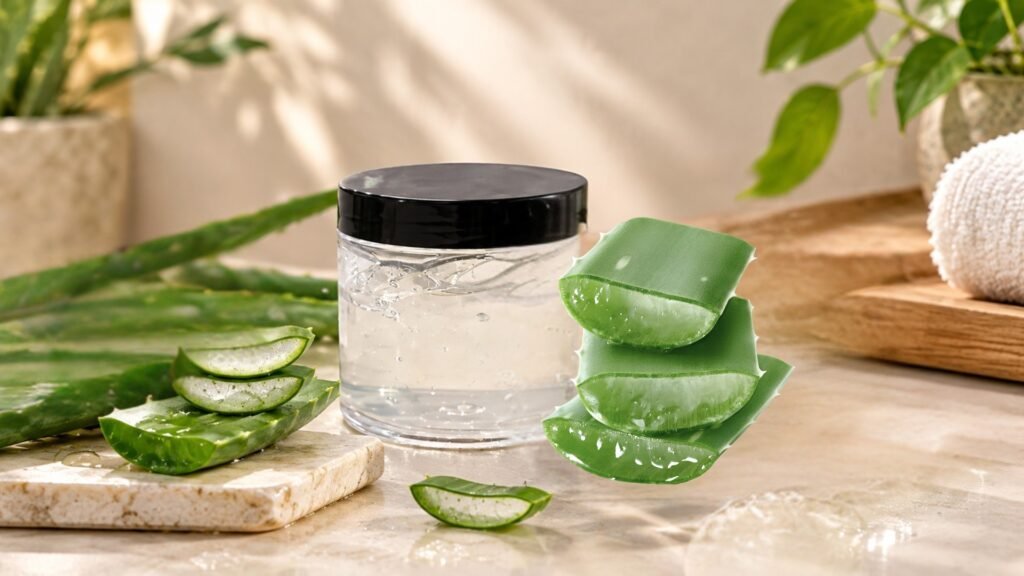
Oak Tree Aloe Vera Gel: A Lightweight Addition to Your Self-Care Routine
If you prefer a ready-to-use aloe product instead of extracting gel from a fresh aloe leaf, Oak Tree Aloe Vera Gel (100 g) is an option from Oak Tree Naturals.
According to the official Oak Tree Naturals website, the product is a lightweight, fast-absorbing aloe vera gel designed primarily for topical skin care. The brand describes it as helping provide hydration while leaving skin feeling soft, cool, and refreshed.
That makes it particularly relevant if you’re already interested in aloe vera as part of a broader personal-care routine.
However, there’s an important distinction for this article:
The official product description currently focuses on skin care rather than specifically claiming a hair-care use.
So if you’re considering using it on your hair or scalp, check the current packaging and directions first rather than assuming that every skin gel is automatically intended for hair.
Common Mistakes People Make With Aloe Vera Gel for Hair
Aloe vera may be simple to use, but simple doesn’t mean there are no mistakes.
Mistake 1: Applying Too Much
A thick layer isn’t necessary.
Start small.
Mistake 2: Expecting Overnight Hair Transformation
Hair texture and condition don’t change permanently because of one application.
Consistency and overall care matter more.
Mistake 3: Assuming Aloe Vera Treats Hair Loss
There isn’t enough evidence to make this claim confidently.
If you’re losing significant amounts of hair, look for the underlying cause instead of relying on a cosmetic gel.
Mistake 4: Ignoring Irritation
Natural ingredients can still cause reactions.
If your scalp becomes itchy, red, or uncomfortable, stop using the product.
Mistake 5: Following Every DIY Hair Hack Online
Not every viral hair-care recipe is backed by good evidence.
Avoid combining multiple ingredients simply because they are trending.
A simple routine is often easier to understand—and easier to troubleshoot.
A Simple Aloe Vera Hair-Care Routine for Beginners
If you want to experiment with aloe vera gel, keep your first routine uncomplicated.
Before You Start
Check the product label and make sure it is appropriate for your intended use.
Your Routine
Step 1: Wash your hair with your usual shampoo.
Step 2: Condition the lengths.
Step 3: Rinse thoroughly.
Step 4: Gently remove excess water.
Step 5: If the product is suitable for your intended hair use, apply a very small amount to the lengths or ends.
Step 6: Let your hair dry naturally or style it as usual.
Step 7: Observe how your hair feels.
If it feels soft and manageable, you can continue experimenting with the routine.
If it feels sticky, stiff, or coated, use less or discontinue it.
The Bottom Line: Could Aloe Vera Gel Become Your Hair-Care Essential?
Dry, frizzy hair can make you feel like you need an entire shelf of products.
You probably don’t.
Aloe vera gel is interesting because of its lightweight texture and long history of topical use. It may fit comfortably into a simple hair-care routine for people who want a lighter-feeling product.
But the smartest approach is to keep expectations realistic.
Aloe vera gel isn’t a guaranteed cure for frizz, and it shouldn’t be marketed as a proven hair-growth treatment.
Instead, think of it as one possible supporting step alongside conditioning, gentle handling, reduced heat exposure, and a routine suited to your hair.
If you’re interested in trying an aloe-based product, Oak Tree Aloe Vera Gel (100 g) is available from Oak Tree Naturals. Its official product description currently focuses on lightweight, hydrating skin care, so check the label and intended-use directions before applying it to your hair or scalp.
Sometimes better hair care isn’t about adding more.
It’s about finding the few things your hair actually responds well to—and sticking with them.
FAQ Section
1. Is aloe vera gel good for dry hair?
Aloe vera gel may be a useful lightweight addition to a dry-hair routine, particularly if you prefer a gel texture. However, results vary by hair type and product formulation, and it should not replace basic conditioning and gentle hair-care practices.
2. Can aloe vera gel help with frizzy hair?
It may help hair feel smoother and easier to manage, which can make frizz less noticeable. However, it does not permanently eliminate frizz, and factors such as humidity, hair damage, and styling habits also matter.
3. Can aloe vera gel help hair growth?
There is not enough strong evidence to say that ordinary aloe vera gel reliably increases hair growth. Research into herbal approaches to hair loss is ongoing, but many proposed treatments still require stronger clinical evidence.
4. Can aloe vera gel be applied directly to the scalp?
Some aloe products are suitable for topical scalp application, but you should check the specific product’s directions first. Topical aloe can occasionally cause itching, burning, rash, or eczema.
5. How much aloe vera gel should I apply to my hair?
Start with a small amount, particularly if you have fine hair. Apply it gradually to the lengths or ends and add more only if necessary. Too much product may leave the hair feeling coated or sticky.
6. Can aloe vera gel replace conditioner?
Not necessarily. Aloe vera gel and conditioner serve different purposes, so aloe gel should not automatically be treated as a replacement for a conditioner.
7. Can I use aloe vera gel every day on my hair?
There is no universal need to use aloe vera gel every day. Start occasionally and observe how your hair and scalp respond. Reduce or stop use if you experience buildup or irritation.