
Bhringraj Oil vs Rosemary Oil: Discover the Best Choice for Your Hair Care Routine

Choosing a hair oil can be surprisingly confusing. Bhringraj oil and rosemary oil are both popular in natural hair-care routines, but they are not identical ingredients and should not automatically be treated as interchangeable.
If you are comparing Bhringraj Oil vs Rosemary Oil, the better choice depends on what you want from your routine: traditional Ayurvedic hair care, scalp nourishment, conditioning, or an ingredient with some human clinical research related to hair growth.
Bhringraj, traditionally associated with Ayurvedic hair care, has shown hair-growth-promoting potential in preclinical studies. Rosemary oil has also attracted scientific interest, including a randomized comparative study involving people with androgenetic alopecia. However, neither should be presented as a guaranteed treatment for hair loss. Hair shedding and hair loss can have many causes, and persistent or sudden changes deserve professional evaluation.
So, Bhringraj Oil vs Rosemary Oil—which one fits your hair-care routine? Let’s look at the differences carefully.
Table of Contents
Bhringraj Oil vs Rosemary Oil: What Is the Difference?
Bhringraj and rosemary come from different plants and have different traditional uses.
Bhringraj refers to Eclipta alba (also commonly referred to as Eclipta prostrata in botanical literature). It has a long history of use in traditional Ayurvedic hair-care practices.
Rosemary comes from Rosmarinus officinalis, now commonly classified botanically as Salvia rosmarinus. Rosemary preparations are widely used in modern cosmetic and personal-care products.
The important distinction is that traditional use, laboratory findings, animal studies, and human clinical evidence are not the same thing.
Feature: Bhringraj Oil vs. Rosemary Oil
Botanical source Eclipta species Salvia rosmarinus
Traditional association Ayurveda and Indian herbal hair care Herbal and botanical personal care
Common hair-care use Scalp oiling and conditioning Scalp and hair-care routines
Research on hair growth Mainly preclinical evidence Some human clinical evidence
Suitable routine Traditional oiling and scalp massage Botanical scalp-care routine
Best approach Use consistently as a cosmetic hair-care oil Use an appropriate, properly formulated preparation
Hair-growth guarantee No No
This comparison highlights an important point: “natural” does not automatically mean clinically proven, and a research study on an ingredient does not mean every product containing that ingredient will produce the same results.
What Is Bhringraj Oil?
Bhringraj oil is a traditional herbal hair oil associated with Eclipta species and Ayurvedic hair-care practices.
Bhringraj has been investigated for potential hair-growth-related activity. In animal studies, Eclipta alba extracts demonstrated activity associated with the hair-growth cycle and follicular changes. However, these studies were conducted in animals, so the results cannot automatically be translated into guaranteed effects in humans.
For everyday hair care, Bhringraj oil is commonly used as a scalp massage and pre-wash oil. It can also help hair feel conditioned, softer, and more manageable.
For someone who enjoys traditional herbal hair oiling, Bhringraj can therefore be an appealing choice.
Potential Benefits of Bhringraj Oil
A well-formulated Bhringraj hair oil may fit into a routine focused on:
- Scalp massage
- Hair conditioning
- Maintaining soft and manageable hair
- Traditional Ayurvedic-inspired hair care
- Pre-shampoo oiling
- Supporting a healthy-looking scalp and hair routine
The phrase “supporting healthy-looking hair” is important. Cosmetic hair oils should not be presented as guaranteed treatments for medical hair loss.
What Is Rosemary Oil?
Rosemary oil is derived from rosemary, an aromatic botanical widely used in personal-care formulations.
Unlike Bhringraj, rosemary has been investigated in a human randomized comparative trial specifically involving androgenetic alopecia.
In a 2015 study, 100 participants with androgenetic alopecia were assigned to rosemary oil or 2% minoxidil for six months. The researchers found no significant change in hair count at three months, while both groups showed increased hair count at six months compared with baseline. The study did not find a significant difference between the two groups in hair count at six months.
That is useful evidence, but it should be interpreted carefully. One clinical trial is not enough to establish rosemary oil as a universal hair-loss treatment.
Bhringraj Oil vs Rosemary Oil for Hair Growth
This is probably the question most readers have.
Bhringraj
Research on Eclipta alba has shown promising results in animal models. For example, studies have observed changes associated with hair-growth activity following topical application of Eclipta extracts.
However, these findings are preclinical. More high-quality human research would be needed to establish how effective Bhringraj preparations are for different types of hair loss.
Rosemary
Rosemary has a stronger human evidence base than Bhringraj for this specific question because of the randomized comparative trial mentioned above. In that study, the rosemary group showed an increase in hair count after six months, although the study was relatively small and focused on androgenetic alopecia.
Therefore, it would be inaccurate to say that Bhringraj or rosemary is definitively “the best” hair-growth oil for everyone.
Instead, consider the type of evidence and your reason for using the oil.
Which Oil Is Better for Traditional Hair Oiling?
If your priority is a traditional Indian or Ayurvedic-inspired hair-oiling routine, Bhringraj may be the more natural fit.
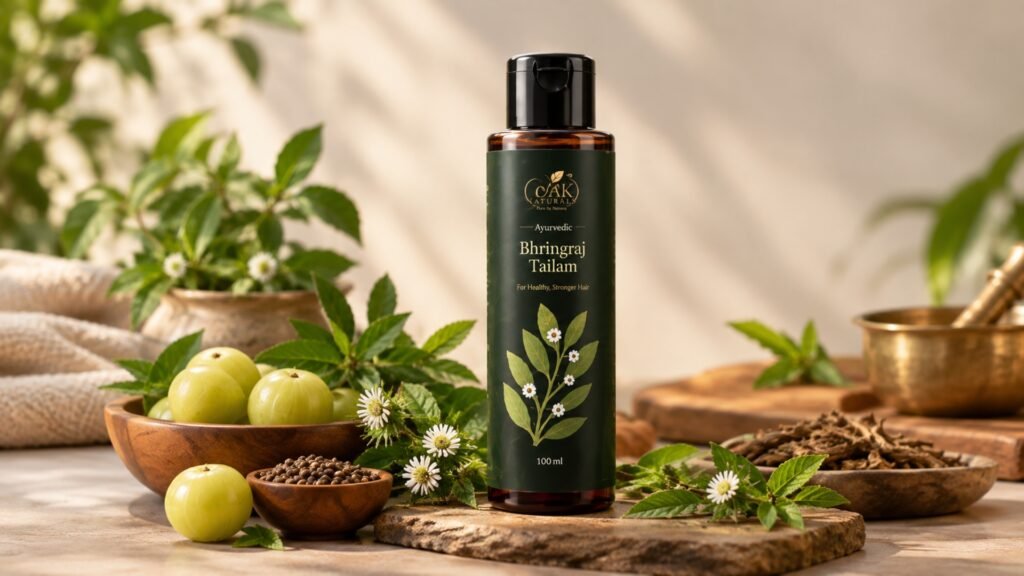
Bhringraj has a long-standing association with Ayurvedic hair care, and Bhringraj Tailam is traditionally used as a hair and scalp oil.
For example, Oaktree Naturals Bhringraj Tailam 100ml is positioned by Oak Tree Naturals as a herbal hair oil intended for scalp and hair care. The product page describes it as a lightweight oil and recommends applying it to the scalp, gently massaging, working the remaining oil through the hair lengths, and leaving it for at least 30 minutes or overnight before washing.
Which Is Better for a Scalp Massage?
Both can be incorporated into a scalp massage routine, provided the formulation is appropriate for your scalp, and you tolerate it well.
The technique matters too.
A simple scalp-oiling method
- Take a moderate amount of oil.
- Apply it to the scalp in sections.
- Massage gently using your fingertips.
- Avoid aggressively scratching the scalp with your nails.
- Spread any remaining oil through the lengths.
- Leave it for your preferred pre-wash period.
- Wash thoroughly with a suitable shampoo.
More oil does not necessarily mean better results. Excessive application can make the hair harder to wash and may leave the scalp feeling greasy.
Bhringraj Oil vs Rosemary Oil for Different Hair Needs
There is no single oil that works identically for every person.
Hair-care goalBhringraj OilRosemary Oil
Traditional Ayurvedic routine Strong fit Moderate fit
Scalp oiling Suitable Suitable depending on formulation
Pre-shampoo treatment Suitable Suitable depending on formulation
Hair conditioning Suitable Depends on carrier/formulation
Hair-growth research Mainly preclinical Some human clinical evidence
Dry-feeling hair Can be used as conditioning oil Can be used as part of a broader routine
Oily scalp Use a smaller amount Use a smaller amount
Persistent hair loss Not a substitute for diagnosis Not a substitute for diagnosis
The most important distinction is between hair care and medical treatment.
If your concern is maintaining soft, conditioned, healthy-looking hair, a suitable hair oil may be a useful part of your routine.
If you are experiencing progressive thinning, bald patches, or sudden excessive shedding, changing your oil alone may not address the underlying cause.
Can Bhringraj Oil and Rosemary Oil Be Used Together?
They can potentially be incorporated into the same broader hair-care routine, but combining ingredients does not automatically make a product more effective.
If you are already using a formulated hair oil, check its ingredient list rather than adding several concentrated botanical oils yourself.
For essential oils such as rosemary essential oil, formulation and dilution are particularly important. Applying concentrated essential oils directly to the scalp can increase the risk of irritation.
A simpler routine is often easier to monitor.
How Often Should You Oil Your Hair?
There is no universally correct oiling schedule.
A practical starting point is once a week, followed by adjustments based on how your scalp and hair respond.
You may prefer more or less frequent oiling depending on:
- Hair thickness
- Hair texture
- Scalp oiliness
- Washing frequency
- Product buildup
- Climate
- Personal preference
If your hair feels heavy or your scalp becomes excessively greasy, reduce the quantity or frequency.
What About Hair Fall?
This is where realistic expectations matter most.
Some daily shedding is normal. The American Academy of Dermatology notes that losing approximately 50–100 hairs per day can be normal. Hair loss, however, can have many different causes, including hereditary hair loss, certain illnesses, hormonal factors, nutritional issues, and damaging hair-care practices.
Tight hairstyles can also contribute to traction alopecia by repeatedly pulling on the hair.
This is why an oil should not be viewed as a universal solution for hair fall.
If you notice:
- Sudden or excessive shedding
- A widening part
- Receding hairline
- Bald patches
- Persistent scalp itching or inflammation
- Noticeably progressive thinning
Consider speaking with a dermatologist. The American Academy of Dermatology emphasizes that identifying the cause is an important part of treating hair loss effectively.
Common Mistakes When Using Hair Oils
1. Using too much oil
Soaking your scalp does not necessarily improve the result. Start with a moderate amount.
2. Scrubbing the scalp aggressively
A scalp massage should be gentle. Excessive friction can make the experience uncomfortable and may contribute to mechanical damage.
3. Expecting overnight hair growth
Hair biology works over time. The rosemary clinical study, for example, did not find a significant change in hair count at three months but did find changes at six months.
4. Treating every type of hair loss with oil
Different causes require different approaches. A cosmetic oil cannot diagnose or treat an underlying medical condition.
5. Assuming every rosemary or Bhringraj product is identical
The concentration, carrier oils, extraction method, and overall formulation can vary significantly between products.
So, Bhringraj Oil vs Rosemary Oil: Which Should You Choose?
The answer depends on your priority.
Choose Bhringraj oil if you are particularly interested in:
- Traditional Ayurvedic-inspired hair care
- Regular scalp oiling
- Herbal hair-care rituals
- Pre-shampoo oil treatments
- Conditioning and maintaining healthy-looking hair
Choose a rosemary-based hair-care product if you are interested in rosemary as a botanical ingredient and value the fact that rosemary has some human clinical research relating to androgenetic alopecia. However, the available evidence is still limited, and a rosemary product should not be considered equivalent to a proven medical treatment.
For readers who prefer a traditional herbal oil, Oaktree Naturals Bhringraj Tailam provides a straightforward way to incorporate Bhringraj into a regular hair-oiling routine. Oak Tree Naturals describes the product as a lightweight herbal hair oil intended for scalp and hair care and recommends using it as a pre-wash treatment.
A Simple Way to Add Bhringraj Oil to Your Routine
If you decide to try Bhringraj oil, keep the routine simple:
Bhringraj oil → gentle scalp massage → wait at least 30 minutes → shampoo → conditioner if needed
Oaktree Naturals specifically recommends applying its Bhringraj Tailam to the scalp, massaging gently, applying the remaining oil through the hair lengths, and leaving it for at least 30 minutes or overnight before washing.
Start with a small amount and observe how your hair and scalp respond.
Final Thoughts
The Bhringraj Oil vs Rosemary Oil comparison does not have one universal winner.
Bhringraj has strong traditional relevance in Ayurvedic hair care and promising preclinical research, while rosemary has some human clinical evidence related to androgenetic alopecia. At the same time, neither should be marketed or understood as a guaranteed solution for hair loss.
For everyday hair care, the most useful approach is to choose an oil based on your routine, hair type, scalp preferences, and expectations.
If traditional herbal oiling is what you are looking for, Bhringraj oil can be a practical addition to a simple pre-wash routine. And if you are dealing with significant or persistent hair loss, focus first on identifying the cause rather than relying exclusively on any hair oil.
FAQ Section
1. Is Bhringraj oil better than rosemary oil?
Neither can be considered universally better. Bhringraj is strongly associated with traditional Ayurvedic hair care, while rosemary has some human clinical evidence relating to androgenetic alopecia. Your choice should depend on your hair-care goals and expectations.
2. Which is better for hair growth, Bhringraj or rosemary?
Rosemary currently has more direct human clinical evidence for hair growth than Bhringraj, but the evidence is still limited. Bhringraj research includes promising animal studies, which cannot be assumed to produce identical results in humans.
3. Can I use Bhringraj oil every day?
You do not necessarily need to oil your hair every day. Starting with once-weekly oiling is a practical approach, after which you can adjust according to your hair and scalp.
4. How long should I leave Bhringraj oil on my hair?
Oaktree Naturals recommends leaving its Bhringraj Tailam on for at least 30 minutes or overnight before washing.
5. Can Bhringraj oil stop hair fall?
Bhringraj oil should not be presented as a guaranteed treatment for hair loss. Hair loss has many possible causes, and persistent or sudden shedding should be evaluated by a dermatologist.
6. Is rosemary oil scientifically proven for hair growth?
There is some human clinical evidence. A randomized study involving people with androgenetic alopecia found increased hair counts after six months in both the rosemary and 2% minoxidil groups, with no significant difference between the groups. More research is needed to establish the broader effectiveness of rosemary oil.
7. Can I use Bhringraj oil and rosemary oil together?
They can potentially be included in the same hair-care routine, but combining oils does not automatically improve results. Concentrated rosemary essential oil should be appropriately formulated or diluted rather than applied indiscriminately.
8. When should I see a dermatologist for hair loss?
Consider professional evaluation for sudden or excessive shedding, progressive thinning, bald patches, or persistent scalp symptoms. Identifying the cause is important because different types of hair loss can require different treatments.











3 thoughts on “Bhringraj Oil vs Rosemary Oil: Discover the Best Choice for Your Hair Care Routine”