
Acne Face Wash for All Skin Types: Discover the Best Skincare Approach


Acne Face Wash for All Skin Types: What Should You Actually Look For?
You wake up, look in the mirror, and there it is again—a new pimple.
So you wash your face a little more thoroughly. Maybe you scrub harder. Maybe you switch to a stronger cleanser because you think your skin needs to be “deep cleaned.”
A few days later, your skin feels tight and dry, but the breakouts haven’t necessarily disappeared.
If this sounds familiar, you’re not alone.
Finding an acne face wash for all skin types can be confusing because acne-prone skin isn’t always oily skin. Some people experience breakouts alongside dryness, sensitivity, or combination skin. Others have skin that becomes irritated whenever they use a cleanser that is too harsh.
The better approach isn’t simply to find the strongest face wash you can.
It’s to find a cleanser that helps remove excess oil, sweat, dirt, and daily buildup without unnecessarily irritating the skin.
The American Academy of Dermatology recommends gently cleansing acne-prone skin, avoiding abrasive scrubbing and limiting washing to twice a day and after sweating.
This is where a simple skincare principle becomes important:
Clean skin doesn’t have to mean stripped skin.
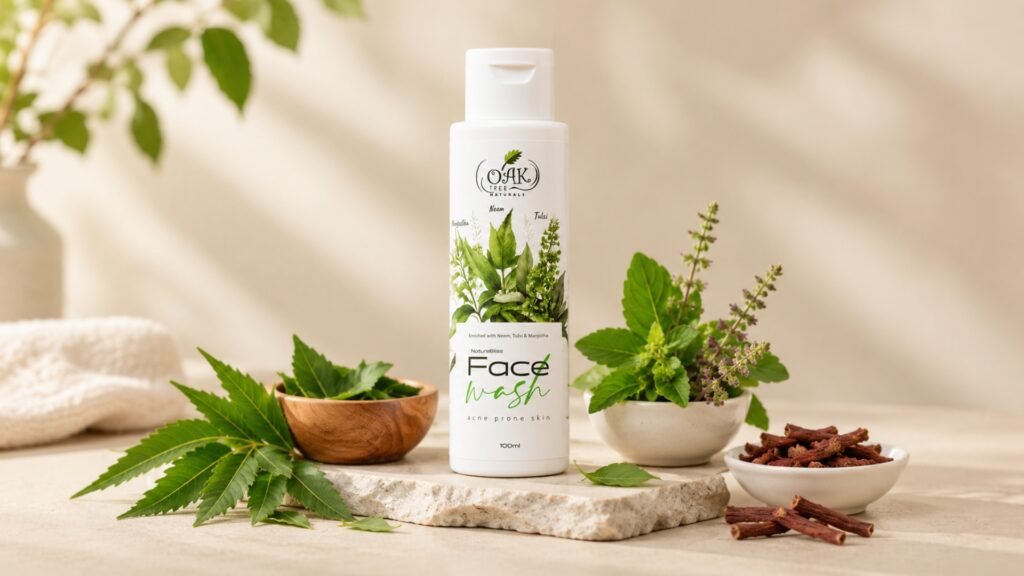
Oaktree Naturals’ Oak Tree Natural Acne Face Wash 100ml is positioned by the brand as a daily-use cleanser designed to cleanse and purify the skin, remove impurities and excess oil, and help maintain the skin’s moisture balance
But before choosing any acne face wash, it’s worth understanding what acne-prone skin actually needs.
Table of Contents
What Makes a Good Acne Face Wash?
A face wash has one basic job: cleanse the skin.
It isn’t supposed to replace every other part of an acne-care routine.
A good acne-friendly cleanser should help remove:
- Excess oil
- Sweat
- Dirt
- Makeup and sunscreen residue
- Everyday impurities
At the same time, it shouldn’t leave your face feeling painfully tight, burning, or excessively dry.
Dermatologists recommend using a gentle, non-abrasive cleanser and applying it with your fingertips rather than scrubbing with a cloth or abrasive tool. This matters because irritation can work against your skincare goals.
The temptation when you have acne is often to attack the problem.
But acne-prone skin usually benefits from consistency and gentleness rather than aggressive cleansing.
Can One Acne Face Wash Really Work for All Skin Types?
This question deserves a nuanced answer.
No single cleanser will feel exactly the same on every person’s skin.
When a product is described as suitable for all skin types, it generally means the formulation is designed with broad usability in mind. It doesn’t mean that every person will experience identical results.
For example:
Dry or acne-prone skin
You may want cleansing without the tight, uncomfortable feeling that can follow washing.
Oily skin
You may appreciate a cleanser that removes excess oil without encouraging you to repeatedly wash your face.
Combination skin
You may have an oily T-zone but drier cheeks. A balanced cleanser can be more useful than a harsh oil-stripping formula.
Sensitive skin
You may need to pay particular attention to how your skin responds to new products.
Oaktree Naturals describes its Acne Face Wash as suitable for daily use and designed to cleanse while preserving the skin’s moisture balance.
Still, individual tolerance matters.
If a product causes persistent burning, itching, redness, or uncomfortable dryness, stop using it and reassess your routine.
Why Over-Cleansing Can Make Acne-Prone Skin Feel Worse
Imagine your skin feels oily, so you wash it three or four times a day.
It feels cleaner—but after a while, your skin starts feeling tight.
You wash it again because you think the oil means you haven’t cleaned enough.
This can become a frustrating cycle.
The NHS advises people with acne not to wash affected skin more than twice a day because frequent washing can irritate the skin and potentially worsen symptoms.
The American Academy of Dermatology similarly recommends washing acne-prone skin twice daily and after sweating.
So if you’re constantly washing your face because you’re worried about acne, more cleansing isn’t necessarily the answer.
A simple morning-and-evening routine is often easier to maintain.
Acne Face Wash for All Skin Types: How to Choose One
When comparing acne face washes, don’t focus only on words such as “strong,” “deep cleansing,” or “oil control.”
Instead, ask a few practical questions.
1. Does it cleanse without excessive dryness?
After washing, your skin should feel clean—not painfully tight.
2. Is it appropriate for regular use?
If you’re using a cleanser twice a day, you want something your skin can comfortably tolerate.
3. Does the formula suit your skin?
Acne-prone skin can also be dry or sensitive. Your skin type still matters.
4. Are you expecting the cleanser to do too much?
A cleanser is a wash-off product. It should not be expected to single-handedly solve every acne concern.
5. Are you using other active products?
If you’re already using acne treatments, adding multiple strong cleansers or exfoliating products can increase irritation.
The AAD specifically cautions against trying too many acne products at once because irritation can make acne more difficult to manage. (American Academy of Dermatology)
How to Use an Acne Face Wash Correctly
Even a good face wash won’t be very helpful if you’re using it incorrectly.
Here’s a simple routine.
Step 1: Wet Your Face
Use lukewarm water.
Very hot water isn’t necessary for cleaning your skin.
Step 2: Take a Small Amount of Face Wash
You don’t need to cover your face in a thick layer of cleanser.
Use enough to cleanse the skin comfortably.
Step 3: Massage Gently
Use your fingertips.
Don’t use your nails.
Don’t scrub aggressively.
The American Academy of Dermatology recommends applying cleanser gently with your fingertips and avoiding abrasive tools because scrubbing can irritate acne-prone skinStep 4: Rinse Thoroughly
Remove the cleanser with lukewarm water.
Step 5: Pat Dry
Don’t aggressively rub your face with a towel.
Step 6: Moisturize
This step is easy to skip when you have oily or acne-prone skin.
But cleansing doesn’t mean your skin doesn’t need hydration.
Dermatologists recommend moisturizing acne-prone skin when dryness is an issue, using products that are appropriate for acne-prone skin.
Step 7: Use Sunscreen During the Day
A simple daytime routine should include appropriate sun protection.
How Often Should You Use an Acne Face Wash?
For most acne-prone skincare routines, twice daily is a common guideline, typically once in the morning and once at night, with an additional wash after heavy sweating when needed. But twice daily doesn’t mean you should scrub twice daily.
Think:
Morning → Gentle cleanse
After heavy sweating → Cleanse/rinse as appropriate
Night → Gentle cleanse
If your skin becomes excessively dry or irritated, reassess your routine rather than automatically increasing cleansing.
7 Common Acne Face-Washing Mistakes
1. Scrubbing Until Your Face Feels “Squeaky Clean”
That squeaky feeling isn’t a badge of successful skincare.
Aggressive scrubbing can irritate acne-prone skin. The AAD specifically recommends gentle cleansing instead of scrubbing.
Better approach: Massage gently with your fingertips.
2. Washing Your Face Too Many Times
If you wash every time you see oil, you’re probably washing too frequently.
The NHS recommends limiting cleansing to twice daily for acne-affected skin.
Better approach: Stick to a consistent routine.
3. Using Extremely Hot Water
Hot water isn’t necessary to remove facial oil.
Use lukewarm water instead.
4. Skipping Moisturizer Because You Have Acne
This is a surprisingly common mistake.
Acne-prone skin can still become dry.
The goal isn’t to eliminate every trace of oil from your face.
It’s to maintain a balanced routine.
5. Changing Products Every Few Days
You see a new pimple and immediately replace your face wash.
Then another product.
Then another serum.
Before long, you have no idea which product is helping—or irritating—your skin.
The AAD recommends giving acne treatments time to work rather than constantly introducing multiple products.
6. Picking Pimples After Washing
You cleanse your face, notice a whitehead and think:
“I’ll just get rid of it.”
Don’t.
Squeezing or picking acne can worsen inflammation and increase the risk of scarring.
7. Expecting a Face Wash to Cure Acne
This may be the biggest expectation mistake.
A cleanser can support good skin hygiene, but persistent acne may need targeted treatment.
Depending on the type and severity of acne, dermatological treatments can include ingredients such as benzoyl peroxide, topical retinoids, or azelaic acid.
A face wash can be one part of the routine, not necessarily the entire routine.
Is Acne Face Wash Suitable for Dry Skin?
Yes, an acne-prone person can have dry skin.
In fact, this is why choosing a cleanser based solely on the word “acne” can be misleading.
If your skin is dry and acne-prone, you want to avoid turning your cleansing routine into another source of irritation.
A gentle cleanser, followed by an appropriate moisturizer, may be more useful than a harsh oil-stripping cleanser.
The AAD recommends gentle cleansing and moisturizing when skin becomes dry or irritated.
What About Oily Skin?
Oily skin and acne frequently appear together, but that doesn’t mean you need to remove every trace of oil.
The AAD recommends a gentle foaming cleanser for oily skin and warns against using excessively harsh products that can irritate the skin
This is an important distinction:
Removing excess oil ≠ stripping the skin.
A balanced cleanser can help you maintain that difference.
What About Combination Skin?
Combination skin can make skincare especially frustrating.
Your forehead and nose may look shiny by lunchtime, while your cheeks feel completely normal—or even dry.
In that situation, don’t assume your entire face needs aggressive oil control.
Use a balanced cleansing approach and pay attention to how different areas of your skin respond.
You may also find that the amount and frequency of other skincare products matter just as much as your cleanser.
Oaktree Naturals Acne Face Wash: What Does It Offer?
Oaktree Naturals’ Oak Tree Natural Acne Face Wash 100ml is positioned as a daily-use cleanser for acne-prone skin.
According to the brand’s current product information, it is intended to:
- Cleanse the skin
- Remove impurities
- Remove excess oil
- Help maintain the skin’s moisture balance
- Support a clearer-looking complexion
- Be suitable for daily use
The product is also listed by Oaktree Naturals under Facial Care and Men’s Care, making it relevant to anyone looking for a straightforward daily cleanser rather than a complicated multi-step treatment.
Explore Oaktree Naturals Acne Face Wash 100ml.
One important distinction is worth making: the brand’s positioning and a dermatologist’s acne-treatment recommendations are not the same thing.
A cosmetic face wash can support cleansing and routine skin care, while moderate or severe acne may require evidence-based medical treatment.
A Simple Acne-Friendly Skincare Routine
If you’re overwhelmed by skincare products, start with the basics.
Morning
1. Cleanser
Use your acne-friendly face wash gently.
2. Moisturizer
Choose one appropriate for your skin.
3. Sunscreen
Use broad-spectrum sunscreen.
Evening
1. Cleanser
Remove the day’s sweat, dirt, sunscreen, and makeup.
2. Treatment if needed
If you’re using an acne treatment recommended by a dermatologist or pharmacist, follow its directions.
3. Moisturizer
Use one appropriate for acne-prone skin.
That’s enough to start.
You don’t need ten products to have a skincare routine.
When Should You See a Dermatologist?
A face wash may be enough to support your everyday routine, but it isn’t appropriate to rely on cleansing alone for every type of acne.
Consider professional medical advice if you have:
- Large or painful pimples
- Deep nodules
- Cysts
- Persistent breakouts
- Acne that is leaving scars
- Acne that isn’t improving with appropriate over-the-counter care
- Breakouts that are significantly affecting your confidence or well-being
The AAD notes that large, painful, deep pimples and acne that causes scarring generally require professional treatment rather than relying only on products purchased in stores.
The NHS similarly recommends medical evaluation for moderate or severe acne, nodules, cysts, or acne that is causing scarring.
The Best Skincare Approach Isn’t the Strongest One
When acne appears, it’s natural to want immediate results.
But good skincare often comes down to doing fewer things consistently.
A sensible acne-friendly approach looks something like this:
Gentle cleansing + appropriate treatment + moisturization + sun protection + consistency
rather than:
Strong cleanser + aggressive scrubbing + multiple new products + constant switching.
If you’re looking for an acne face wash for all skin types, start by asking whether the cleanser can fit comfortably into your routine.
Does it cleanse without leaving your skin excessively dry?
Can you use it consistently?
Does your skin tolerate it?
Are you pairing it with the rest of your routine appropriately?
Those questions are more useful than simply asking whether a face wash is “powerful.”
Final Takeaway
An acne face wash for all skin types should be thought of as part of a balanced skincare approach—not a miracle solution.
Acne-prone skin still needs gentle care, even when it feels oily.
Cleanse without aggressive scrubbing. Avoid repeatedly washing your face throughout the day. Moisturize when your skin is dry. Don’t squeeze your spots. And if your acne is persistent, painful, or leaving scars, get professional advice rather than simply changing cleansers.
Oaktree Naturals’ Acne Face Wash 100ml is positioned as a daily cleanser that removes impurities and excess oil while helping maintain the skin’s moisture balance.
For someone looking to simplify their daily cleansing routine, it can be considered one part of a broader acne-friendly skincare approach.
The real goal isn’t “perfectly oil-free skin.”
It’s clean, comfortable, balanced skin with a routine you can actually stick to.
FAQ Section
1. What is the best acne face wash for all skin types?
There isn’t one cleanser that is universally best for everyone. Look for a gentle cleanser that removes impurities and excess oil without causing excessive dryness or irritation.
2. Can acne face wash be used on dry skin?
Yes. People with acne can also have dry skin. Choose a gentle cleanser and follow it with an appropriate moisturizer if your skin feels dry.
3. How many times should I use an acne face wash?
A common recommendation is twice a day—morning and evening—and after heavy sweating when needed. Washing excessively can irritate acne-prone skin.
4. Can I use acne face wash every day?
Yes, if the particular product is designed for regular use and your skin tolerates it. Oaktree Naturals describes its Acne Face Wash as suitable for daily use.
5. Should I scrub my face if I have acne?
No. Scrubbing can irritate acne-prone skin and potentially worsen breakouts. Dermatologists recommend gentle cleansing with your fingertips
6. Should I moisturize after using acne face wash?
If your skin feels dry, moisturizing is important. Choose a moisturizer appropriate for acne-prone skin rather than skipping moisturizer altogether.
7. Can a face wash completely cure acne?
Not necessarily. A cleanser can support your skincare routine, but persistent or moderate-to-severe acne may require targeted medical treatment.
8. When should I see a dermatologist for acne?
See a dermatologist if you have painful or deep acne, cysts, significant scarring, persistent breakouts, or acne that isn’t responding to appropriate care.













One thought on “Acne Face Wash for All Skin Types: Discover the Best Skincare Approach”